



 Maya Robertson
Consumers are increasingly turning to social platforms for product discovery, as new research highlighted by Meta points to changing search behaviors and a growing role for visual content, creators, and short-form video in the purchase journey.
The findings come from Meta’s latest Social Search Narrative report and supporting research, which examine how product exploration is moving beyond traditional keyword searches toward social-first experiences across platforms such as Facebook and Instagram.
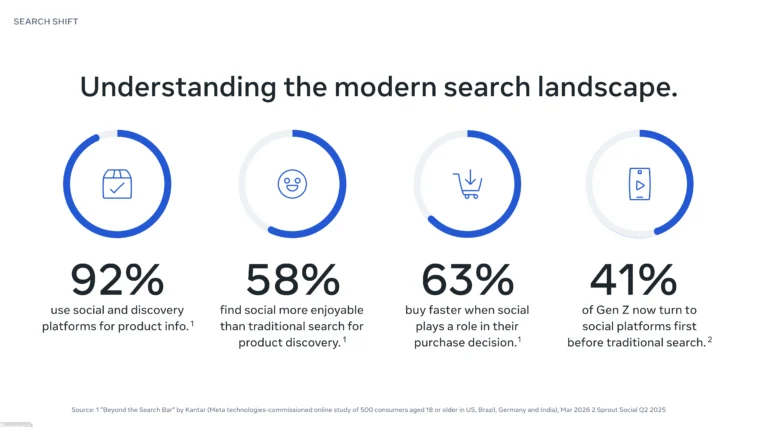
According to the report, Google searches per U.S. user declined nearly 20% year-over-year, while consumers increasingly relied on social environments for discovery and purchase inspiration. The study found that 92% of surveyed users use social platforms for product information, compared to 79% who use traditional search engines.
Meta positions this shift not as a replacement of traditional search, but as the emergence of two parallel discovery behaviors. Traditional search remains focused on utility and intent-driven queries, while social search is increasingly tied to exploration, recommendations, creator content, and visual experiences.
Visual content appears to be a central factor behind this transition. The report found that 61% of consumers said purchases often begin after seeing visually appealing content, while 58% described social discovery as more enjoyable than conventional search experiences. In addition, 63% said social platforms accelerate buying decisions and 65% reported greater purchase confidence when social content plays a role.
Short-form video and creator-led content continue to influence this behavior. Meta argues that users are now encountering products within entertainment feeds rather than actively searching for them, shifting the first stage of purchase intent earlier in the customer journey.
The company also highlighted performance data linked to advertising outcomes. Independent measurement cited in the report indicated that 64% of Meta-driven incremental conversions came from new-to-brand customers, suggesting social discovery may contribute to customer acquisition beyond existing demand capture strategies.
The broader shift has implications for marketers adapting content strategies. Rather than optimizing solely for search rankings and text-based queries, brands are increasingly expected to produce visual assets, creator collaborations, demonstrations, and social-first content designed for discovery environments.
The report further points to artificial intelligence becoming part of this evolution, as platforms increasingly combine search signals, product content, recommendations, and behavioral data to influence discovery and purchasing decisions.
Meta’s analysis is based on consumer research conducted across the U.S., Brazil, Germany, and India, alongside campaign performance studies and broader search trend data covering 2025 and early 2026.



Comments
Loading…