



 Sophie Blake
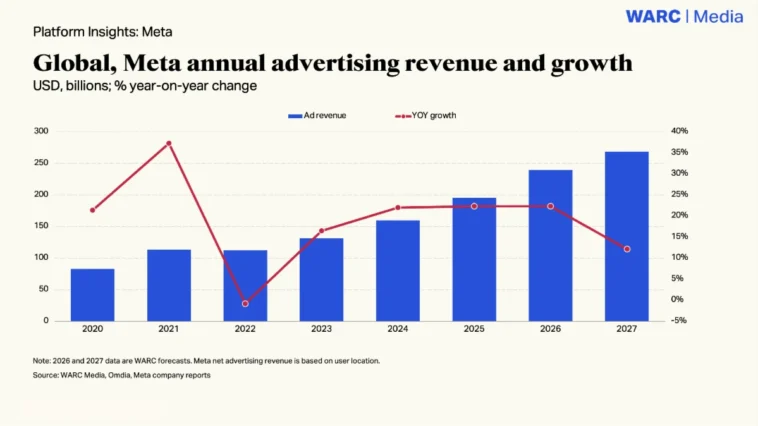
Meta’s advertising business is projected to exceed $240 billion in revenue in 2026, according to a new report from WARC Media, as the company continues expanding its AI-powered advertising and automation infrastructure across Facebook and Instagram.
The report estimates that Meta generated $196 billion in advertising revenue in 2025, representing 22% year-over-year growth. WARC forecasts another 22.3% increase this year, while growth is expected to moderate to 12.1% in 2027 as the company faces rising infrastructure costs and slower user expansion.
Meta’s recent growth has increasingly been tied to AI-driven campaign automation, attribution systems, and performance optimization tools. The company has shifted its advertising strategy away from simply increasing ad volume toward improving monetization efficiency through machine learning models and automated ad delivery.
According to WARC, Meta’s Q4 2025 AI model rollout contributed to a 24% increase in incremental conversions through improved attribution capabilities. Separate analysis from Fospha found that Meta’s cost-per-purchase performance improved 4.5% year over year.
The report also highlighted the growing role of automated campaign products such as Advantage+, which reportedly delivered 41% higher blended return on ad spend and reduced new customer acquisition costs by 17% compared to manually managed campaigns.
Short-form video continues to play a central role in Meta’s engagement strategy. Reels now accounts for 45% of engagement on Instagram and 29% on Facebook, while time spent watching video content on Facebook increased 8% quarter over quarter globally.
Meta reported that more than 3.5 billion people use at least one of its apps daily. However, the company also experienced its first decline in daily active users earlier this year, partly linked to platform restrictions in Russia and Iran.
WARC noted that Meta’s future growth strategy increasingly depends on generating more revenue from existing audiences, particularly in regions with high engagement but lower monetization levels, including Latin America and Sub-Saharan Africa. The company has also started expanding advertising products on newer platforms such as Threads, including ad rollouts in Brazil.
Instagram continues gaining importance among advertisers. WARC’s Voice of the Marketer survey found that more than 55% of global marketers plan to increase spending on Instagram this year, compared to 25% for Facebook. The platform was also ranked as the second most preferred media brand among marketers after YouTube, with more than 40% of respondents citing Instagram as one of the platforms delivering the highest audience attention.
At the same time, investor concerns around Meta’s AI spending continue to grow. During its latest earnings call, the company increased its projected annual AI-related capital expenditure to between $125 billion and $145 billion. Because Meta’s business remains heavily dependent on advertising revenue, analysts are closely monitoring whether AI investments can continue generating sustained revenue growth without significantly affecting profitability.
The report concludes that Meta’s business is increasingly operating as an AI-led advertising ecosystem, where automation, predictive models, and machine learning systems are becoming the primary drivers of campaign delivery, targeting, and monetization.



Comments
Loading…