






Google Play is expanding its subscription infrastructure with new billing and packaging models designed for apps whose monetization does not fit neatly into traditional fixed recurring plans, with generative AI services among the main use cases targeted by the changes.
The new capabilities include Usage-Based Billing, Multi-Quantity Subscription Purchase, Mixed Carts and Cross-Developer Bundling, alongside additional tools aimed at reducing subscription churn and recovering failed payments. Google says some of the features are already available, while others are being tested or rolled out through its Early Access Program.
The changes come as app developers increasingly operate services with variable costs, particularly generative AI products where expenses can depend on how frequently users generate images, text, video or other content.
One of the biggest additions is Usage-Based Billing, which introduces prepaid metered billing to Google Play subscriptions. Instead of charging users only through a fixed recurring subscription, developers will be able to maintain a prepaid balance tied to usage. Users can configure their balance to automatically top up when it falls below a specified threshold.
Google specifically identifies AI generation tools and other usage-based services as potential applications for the model. The approach gives developers another option for products where individual customers can generate substantially different computing costs. Rather than placing every subscriber within the same fixed monthly allowance, apps could connect spending more closely with actual consumption.
The feature also reflects the changing economics of subscription apps as generative AI becomes integrated into more consumer and business services. AI inference can create recurring infrastructure costs that fluctuate depending on how heavily individual customers use a product.
Google is also introducing Multi-Quantity Subscription Purchase, targeting apps that sell access to businesses, schools, teams and other groups. The feature allows a customer to purchase multiple subscriptions within a single transaction and then assign individual seats or subscriptions to team members or students.
Google points to productivity, EdTech and generative AI apps as categories where multi-seat subscriptions could be particularly relevant. The model effectively extends Play subscriptions beyond the conventional one-account, one-subscription structure and gives developers another way to sell Android app access to groups.
For developers targeting business customers, it could also reduce the need to create separate purchasing processes outside the standard Google Play subscription infrastructure.
Another addition, Mixed Carts, changes how developers can package recurring subscriptions alongside other digital products. Previously, a subscription and a one-time product generally required separate transactions. Under the new model, an auto-renewing subscription and one-time products can be processed through a single API call and presented within one checkout flow.
That could allow an app, for example, to sell a monthly subscription alongside additional credits, virtual currency or another one-time digital item without requiring the customer to complete two purchases.
Developers can also use the system to create bundled discounts involving recurring and one-time products. For AI apps, the structure could potentially support a recurring base subscription combined with additional generation credits or other usage-related purchases.
Google is also working on Cross-Developer Bundling, allowing multiple subscriptions to be packaged into a single product. Developers will be able to create a bundle containing two or more complementary subscriptions, either from their own portfolio or in partnership with another developer.
Google gives the example of a language-learning service combining its subscription with a premium travel guide from another developer and selling the two together under one SKU.
The model introduces another route for subscription partnerships on Google Play, where separate app businesses could jointly package their paid services rather than relying entirely on independent subscriptions.
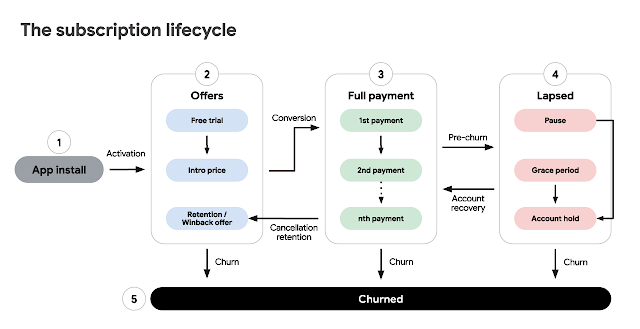
The subscription changes extend beyond new ways of charging customers. Google is also expanding features intended to keep existing subscribers and recover revenue when payments fail.
Its In-App Messaging API, already available to developers, can display payment-related messages directly inside an app. Developers can use the system to ask subscribers to resolve declined payments or inform them about upcoming price changes.
Google is also introducing a Dynamic Grace Period system that uses machine learning and heuristic models to determine how much time individual subscribers receive to resolve a failed payment.
Rather than applying the same grace period to every subscriber, Play can adjust the duration based on the estimated likelihood that a payment will be recovered. The subsequent account-hold period is then adjusted so the developer’s overall configured recovery window remains unchanged.
Developers are also getting additional options for users who actively cancel subscriptions. With Retention Offers, developers can present incentives such as discounts during the Play Store cancellation process. A separate Plan Change option can direct customers toward a lower-priced subscription tier when another promotional offer is not available.
Google is also extending re-engagement to customers who have already canceled. Subscription Winback Offers allow developers to present personalized offers directly through Google Play to former subscribers. That means a developer can potentially reach a lapsed customer through the store even if the user has removed the app and can no longer receive its push notifications.
Behind those developer-controlled features, Google says Play continues to use automated payment retries, backup payment methods for users who have enabled them, payment reminders and fraud-prevention systems to reduce involuntary churn.



Comments
Loading…