






Google has introduced a series of updates aimed at improving Android developer productivity, expanding its AI-assisted development tools and adding new resources designed to support increasingly automated software workflows.
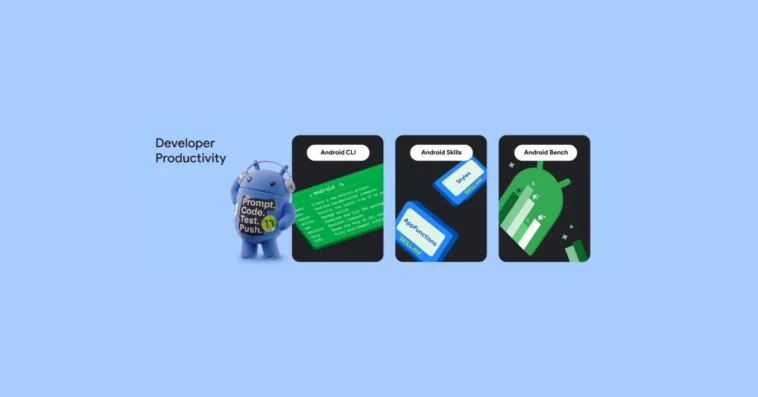
The announcements, highlighted in a new developer update following Google I/O 2026, focus on three areas: the general availability of Android CLI 1.0, an expanded library of Android-specific AI skills, and new additions to Android Bench, Google’s benchmarking platform for evaluating large language models on Android development tasks.
One of the most significant changes is the release of Android CLI 1.0. The command-line tool is now officially stable and includes new capabilities that allow AI agents to interact directly with Android Studio. Google said the integration enables developers to combine automated workflows with Android Studio’s existing tools, including project navigation, performance profiling, Compose previews, and device streaming.
The company is also extending support for Android development within Google Antigravity, its AI-focused development environment. Through a dedicated Android resources bundle, developers can access Android CLI tools and Android-specific knowledge packages that allow AI agents to assist with tasks ranging from project creation to deployment on virtual devices.
Google is also expanding its collection of Android skills, specialized workflows designed to help AI models handle common development challenges and follow recommended Android development practices. The repository now includes more than 17 skills covering areas such as adaptive user interfaces, CameraX migration, Wear OS development, testing configuration, credential management, XR development, and performance analysis.
The additions reflect Google’s broader effort to improve the quality of AI-generated code by providing development-specific guidance rather than relying solely on general-purpose language models. The company said these skills are available through Android CLI and GitHub, allowing developers to install and use them within their workflows.
Another update focuses on Android Bench, Google’s evaluation platform for measuring how AI models perform on real-world Android development tasks. Google has expanded the benchmark to include additional open-source models alongside its own Gemini family, including Gemma 4 and Gemini 3.5 Flash.
According to Google, future versions of Android Bench will introduce more complex and longer-running development challenges designed to test how AI systems handle larger projects and multi-step workflows. The company said the goal is to encourage improvements in AI-assisted software development while providing developers with greater transparency into model capabilities.

The updates arrive as Google continues to position AI-assisted development as a central part of the Android ecosystem. Recent announcements across Android Studio, Gemini, and Google’s broader developer platform have increasingly focused on agent-based workflows that can assist with planning, coding, testing, debugging, and deployment.
While the new tools aim to reduce development time and automate repetitive tasks, they also highlight the growing role AI is expected to play throughout the Android application lifecycle. With Android CLI now stable, a larger catalog of Android-specific skills available, and expanded benchmarking efforts underway, Google is continuing to build the infrastructure needed to support AI-assisted Android development at scale.




Comments
Loading…