



 Maya Robertson
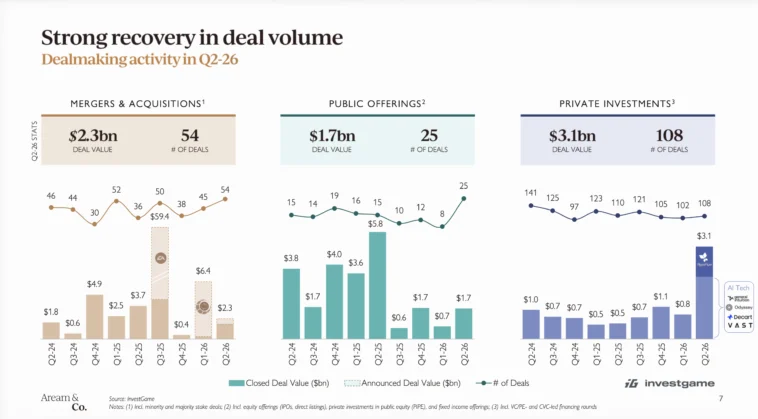
Global gaming mergers and acquisitions totaled $2.3 billion across 54 announced and completed transactions in Q2 2026, marking a continued recovery in deal activity as mid-market acquisitions and private investments gained momentum, according to Aream & Co.’s Q2 2026 Video Game Market Update. The quarter also saw private investment surge to $3.1 billion across 108 deals, driven by several large fundraising rounds in ad tech and AI.
The report shows that gaming dealmaking remained resilient despite ongoing pressure on public gaming stocks. While strategic buyers continued to dominate acquisitions, the market was supported by an increase in transactions valued above $100 million, particularly involving PC gaming studios, mobile developers, and gaming technology companies.
Mid-market acquisitions drove M&A activity
M&A accounted for 25 transactions worth $1.7 billion during the quarter, with several high-profile deals shaping the market. Among the largest was the closing of Loom’s acquisition, valued at approximately $1 billion, alongside the announcement of the planned sale of Wemade founder Park Kwan-ho’s controlling stake, valued at roughly $600 million.
According to Aream & Co., acquisitions valued above $100 million reached their highest level since the pandemic-era investment boom. PC gaming remained one of the most active segments through transactions involving companies such as Playstack and CCP Games, while casual mobile developers including Loom, JustPlay, and Bluetile also attracted significant buyer interest.
Private funding climbed nearly sixfold
Private investment represented the strongest area of capital deployment during the quarter. Total funding reached $3.1 billion, an increase of roughly six times year over year, while deal volume remained broadly stable at 108 transactions.
The largest financings were concentrated in artificial intelligence and advertising technology. Notable rounds included AppsFlyer’s approximately $1 billion investment, alongside major financings for AI companies including General Intuition, Odyssey, and Decart, highlighting growing investor interest in technologies supporting game development, advertising, and content creation.
Public offerings gained momentum
Public capital markets also became more active. The number of public offerings increased 67% year over year, led by Liftoff’s approximately $503 million IPO, PlaySimple’s planned $350 million public listing, and Fellowship Entertainment’s announcement that it intends to spin off its gaming business.
Despite the rebound in fundraising activity, Aream & Co. noted that publicly traded gaming companies generally remained under pressure, with most gaming stocks posting year-to-date declines even as financial results across the sector remained relatively stable.
Mobile gaming softened while PC remained resilient
The broader gaming market produced mixed results during the quarter.
According to the report, mobile in-app purchase (IAP) revenue declined 4% year over year, while mobile game installs fell 12%, reaching multi-year lows. The slowdown reflects continued challenges in user acquisition and monetization following several years of normalization after the pandemic.
By contrast, the PC gaming market continued to expand. Steam recorded 13% year-over-year growth in the last twelve months, while concurrent player counts remained close to record highs despite seasonal softness during Q2, reinforcing PC gaming’s resilience.
Console gaming revenue was largely stable, increasing 3% year over year. The launch of the Nintendo Switch 2 helped drive approximately 90% year-over-year quarterly growth for Nintendo’s platform, offsetting declines in PlayStation (-5%) and Xbox (-7%) software revenue.
AI and gaming infrastructure remain investment priorities
Beyond traditional game studios, investors continued allocating capital toward AI-powered development tools, advertising platforms, and gaming infrastructure providers. The report suggests buyers are increasingly pursuing technologies that improve game production, monetization, user acquisition, and operational efficiency rather than focusing exclusively on content acquisitions.
With M&A volumes continuing to recover, private investment reaching multi-billion-dollar levels, and larger mid-market transactions returning, Aream & Co. concludes that gaming investment activity strengthened further during the second quarter, even as mobile gaming performance softened and public market valuations remained subdued.


Comments
Loading…