



 Maya Robertson
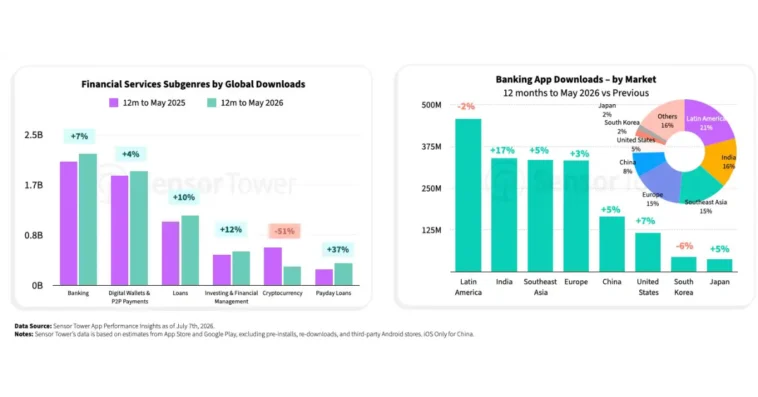
Banking apps remained the largest segment within the global Financial Services app market over the 12 months ending May 2026, generating approximately 2.3 billion downloads, a 7% year-over-year increase, according to Sensor Tower’s State of Digital Banking 2026 report. The figures underscore continued consumer demand for mobile banking despite an increasingly competitive fintech landscape.
The report shows that traditional banks continue to attract the largest share of new mobile users, even as digital-first financial platforms expand their offerings. Banking apps accounted for the highest download volume across the broader Financial Services category, outperforming segments such as digital wallets, investment platforms, lending apps, and insurance services. The steady growth reflects the ongoing shift toward mobile-first banking experiences, with consumers increasingly relying on apps for everyday financial management.
While download growth remained healthy, engagement has become an increasingly important battleground. Financial institutions are investing more heavily in features that encourage users to interact with their banking apps more frequently, including personalized financial insights, integrated payment services, budgeting tools, rewards programs, and AI-powered customer support. Rather than competing solely on customer acquisition, banks are increasingly focused on improving long-term engagement and retention.
Sensor Tower also highlights the growing influence of digital-only banks, which continue to challenge established financial institutions through streamlined onboarding, lower fees, and feature-rich mobile experiences. Although incumbent banks still dominate total downloads, challenger banks have maintained strong momentum in several markets by expanding beyond basic banking into savings, investing, lending, and financial planning services.
Artificial intelligence is emerging as another major driver of product development across the sector. Banks are increasingly incorporating AI into their mobile platforms to power conversational assistants, fraud detection, spending analysis, and personalized financial recommendations. These capabilities are helping financial institutions automate customer service while delivering more tailored user experiences.
Regional performance varied throughout the period, reflecting differences in digital banking maturity and consumer adoption. Mature markets continued emphasizing customer engagement and cross-selling financial products, while emerging markets recorded stronger download growth as smartphone adoption, digital payments, and financial inclusion initiatives expanded access to mobile banking services.
The report suggests that competition within digital banking is shifting beyond simply acquiring users. As banking apps continue to attract billions of downloads annually, success is increasingly being measured by customer retention, feature adoption, and the ability to consolidate multiple financial services into a single mobile experience. With 2.3 billion downloads over the past year, banking remains the dominant category within financial services apps, reinforcing its central role in the evolving mobile economy.



Comments
Loading…