






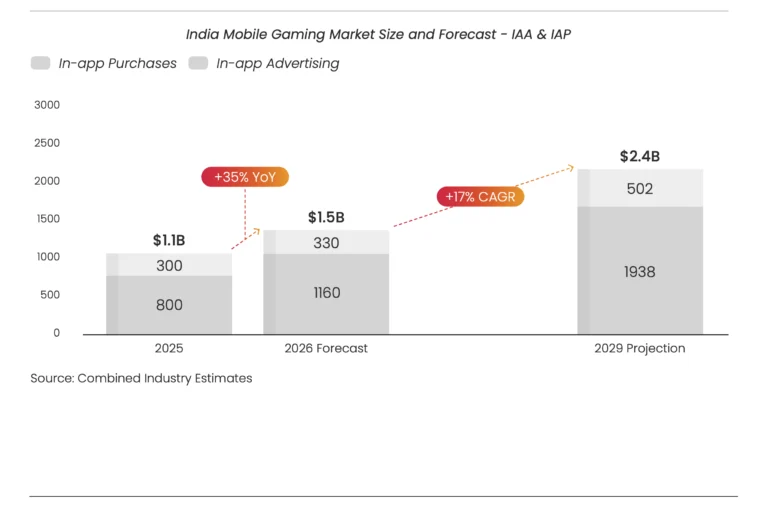
India’s mobile gaming market is projected to grow from $1.5 billion in 2026 to $2.4 billion by 2029, representing a 17% compound annual growth rate (CAGR), according to MIXI Global Investments’ India’s State of Play report. The forecast suggests the market is entering a new phase of maturity, with stronger monetization and increasing investment expected despite slower download growth.
The report estimates that combined in-app purchases (IAP) and in-app advertising (IAA) revenue will reach $1.5 billion in 2026, up 35% year over year from approximately $1.1 billion in 2025. While advertising remains a key revenue driver, the market is gradually shifting toward higher-value in-app purchases as players spend more on midcore gaming experiences.
According to the report, India surpassed $800 million in IAP revenue in 2025, more than doubling in-app purchase revenue over the past five years. The report attributes this growth to players moving beyond ad-supported casual games toward genres with deeper progression systems and stronger monetization mechanics, a trend previously observed across other Southeast Asian gaming markets.
Advertising, however, continues to play a central role in the country’s gaming economy. In-app advertising generated an estimated $300 million in 2025—more than one-third of total mobile gaming revenue. Given India’s relatively low average revenue per user (ARPU) and limited credit card penetration, ad-supported and hybrid monetization models remain the dominant approach for reaching mass-market audiences. Hypercasual games, in particular, continue to serve as the primary entry point for new mobile gamers.
Despite revenue growth, download volumes have stabilized. India continues to generate nearly 8 billion game downloads annually, with Google Play accounting for the overwhelming majority of installs. Downloads declined only 2.7% through 2025, indicating that player acquisition has remained relatively resilient even as engagement patterns shifted following regulatory changes affecting the Real Money Games (RMG) sector. Total time spent in mobile games declined 8.4%, reflecting changing player behavior after the RMG restrictions introduced in 2025.
The report suggests those regulatory changes could ultimately benefit the broader mobile gaming ecosystem. As investment and talent move away from real-money gaming, publishers are expected to redirect resources toward free-to-play titles, while some former RMG players transition to conventional mobile games. Combined industry estimates indicate that the post-RMG environment could help drive stronger growth in traditional gaming, particularly in genres built around in-app purchases.
India’s scale remains one of its biggest competitive advantages. The country ranks first globally in total game downloads, average monthly active users, and projected annual MAU growth, supported by a population of approximately 1.5 billion people. Revenue has continued to expand alongside engagement, although spending per player remains below more mature gaming markets, leaving significant room for future monetization gains.
The report also highlights India’s cost-efficient user acquisition environment. According to AppsFlyer data cited in the report, gaming cost-per-install (CPI) has fallen to approximately $0.05, making India one of the world’s lowest-cost markets for acquiring mobile game users. Combined with rising in-app purchase revenue, the lower acquisition costs continue to make India an attractive testing ground for publishers before launching games globally.
The report notes that the country’s gaming audience remains predominantly young, with players aged 18 to 34 accounting for 77% of gamers, while 86% of players are male. However, genres such as puzzle and lifestyle games are attracting higher proportions of female and older users, suggesting opportunities to expand gaming beyond its traditional audience.
India’s game development ecosystem is also expanding rapidly. More than 2,000 gaming companies now operate in the country, reflecting a shift from outsourcing services toward original intellectual property, gaming technology, and global content creation. The report argues that growing institutional support, increased investment, AI-powered development tools, and stronger localization capabilities are positioning Indian studios to compete more effectively in international markets.
According to the report, the combination of improving monetization, a large addressable audience, lower acquisition costs, and an increasingly sophisticated developer ecosystem places India among the fastest-growing mobile gaming markets globally. If current trends continue, the sector is expected to surpass $2.4 billion in annual revenue by 2029, driven by continued adoption of in-app purchases, expanding free-to-play experiences, and sustained investment in local game development.



Comments
Loading…