






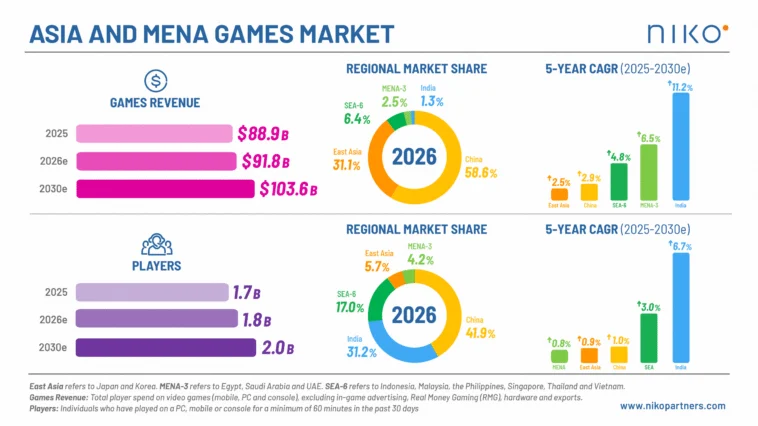
The video game market across Asia and the Middle East and North Africa (MENA) is on track to surpass the $100 billion revenue milestone by the end of the decade, driven by continued growth in emerging markets, rising player spending, and an expanding gamer population.
According to Niko Partners’ latest report, video game revenue across the 13 markets it tracks reached $88.9 billion in 2025, representing a 2.6% year-over-year increase. The research firm forecasts revenue to grow to $91.8 billion in 2026 before reaching $103.6 billion by 2030, reflecting a five-year compound annual growth rate (CAGR) of 3.1%.
The total number of gamers across Asia and MENA is also expected to continue expanding, rising from 1.77 billion players in 2026 to nearly 2 billion by 2030.
While China, Japan, and South Korea remain the region’s largest gaming markets, accounting for a projected $91.7 billion in revenue by 2030, some of the fastest growth is expected to come from emerging economies.
India stands out as the fastest-growing market in Niko Partners’ coverage, having already surpassed 500 million players. The country’s gaming revenue is projected to approach $2 billion by 2030, supported by an 11.2% CAGR over the next five years. Mobile gaming spending in India is expected to exceed $1 billion as early as 2027, with growth increasingly coming from genres beyond battle royale titles.
The MENA-3 markets—Saudi Arabia, the United Arab Emirates, and Egypt—are forecast to become the second-fastest-growing region by revenue. Combined player spending across these markets is expected to reach $3 billion by 2030, while average revenue per user continues to rise.
Southeast Asia is also expected to contribute significantly to future growth. Thailand is projected to cross the $2 billion player spending mark, while Indonesia could reach $1.5 billion in gaming revenue by 2030. Indonesia and Vietnam are forecast to record some of the strongest increases in player numbers, reaching 144 million and 68 million gamers respectively.
The report highlights several structural shifts shaping the market. Female participation in gaming continues to increase, with women now representing 42% of players across Asia and MENA, compared to 39.5% a year earlier. In markets such as India and MENA, where gaming audiences historically skewed heavily male, the gender balance is gradually broadening.
Alternative monetization models are also gaining traction. More than 30% of players across the region now prefer making purchases outside traditional app store ecosystems, reflecting growing interest in direct-to-consumer payment channels following regulatory changes in several markets.
Meanwhile, growth is becoming more diversified across gaming segments. In China, mini-games now account for nearly 20% of mobile game spending, while Japan’s PC gaming market continues to expand. Across the region, publishers are increasingly balancing opportunities in high-spending mature markets with user acquisition efforts in rapidly growing territories.
Niko Partners also noted increasing adoption of generative AI among game developers across Asia. While player sentiment toward AI remains mixed, the report found that consumers generally support its use in development workflows rather than for replacing core creative content.
Despite challenges including inflation, currency fluctuations, rising hardware costs, and geopolitical tensions, Niko Partners expects Asia and MENA to continue outpacing global gaming market growth through 2030 as new cohorts of paying players enter the ecosystem.




Comments
Loading…