







The global mobile gaming industry is entering a new phase in which sustainable player engagement, diversified monetization, and increasingly sophisticated marketing technologies are becoming more important than download volume alone. Across 2025 and 2026, mobile game publishers and developers have faced a changing competitive environment shaped by privacy restrictions, evolving player expectations, artificial intelligence, and the growing convergence of mobile, PC, and console gaming.
Mobile gaming remains one of the largest segments of the broader gaming industry. However, its underlying business model is changing. The traditional formula of acquiring users through paid advertising, generating revenue through in-app purchases (IAPs), and optimizing campaigns around short-term return on ad spend (ROAS) is giving way to more complex strategies. Publishers are exploring direct-to-consumer commerce, hybrid monetization, cross-platform ecosystems, predictive lifetime value modeling, and AI-assisted creative production.
Meanwhile, technologies such as augmented reality (AR), spatial computing, and cloud gaming are expanding the possibilities for game development and player interaction. Although next-generation 6G networks remain a longer-term prospect, their potential implications for immersive gaming and mobile connectivity are already becoming part of the industry’s technology discussion.
This report examines the most significant global mobile gaming trends across 2025 and 2026, their implications for mobile game marketing and monetization, and the strategic considerations shaping the next generation of mobile entertainment.
Key findings: Global mobile gaming trends in 2025–2026
- Mobile gaming remains a major revenue driver: The market continues to account for a substantial share of global games revenue, although growth varies considerably across regions, genres, and monetization models.
- Hybrid-casual models are reshaping mobile game economics: Developers increasingly combine accessible gameplay with progression systems, in-app purchases, and advertising to improve retention and lifetime value.
- Direct-to-consumer monetization is expanding: Web shops, loyalty programs, and alternative payment channels are giving publishers more options for managing player relationships and revenue.
- Cross-platform ecosystems are influencing retention: Cross-progression, unified player identities, and connected communities are becoming increasingly important for games operating across multiple devices.
- AI is changing user acquisition workflows: Generative creative tools, predictive analytics, and automated campaign optimization are accelerating marketing experimentation.
- Spatial computing remains an emerging opportunity: AR and mixed-reality experiences are creating new possibilities for immersive marketing, although adoption and commercial scalability remain limited.
- 6G is a future infrastructure consideration, not a 2026 commercial reality: Its potential impact on cloud gaming and high-fidelity interactive experiences should be evaluated alongside more immediate developments in 5G, Wi-Fi, edge computing, and device performance.
1. State of the global mobile gaming sector in 2025
Mobile gaming’s position in the global games economy
Mobile gaming entered 2025 as an established pillar of the global interactive entertainment market. Smartphones have become the primary gaming device for large populations, supported by accessible app distribution, expanding mobile internet connectivity, and business models that reduce the initial cost of participation.
According to Newzoo’s 2025 Global Games Market Report, the worldwide games market was projected to generate approximately $188.8 billion in 2025, with mobile gaming accounting for roughly $103 billion, or about 55% of total revenue. These estimates illustrate the economic importance of mobile gaming, even as publishers face increasing pressure to improve acquisition efficiency and monetize existing audiences.
The distinction between market scale and market growth is particularly important. A large revenue base does not necessarily translate into uniform expansion across the industry. Established titles can continue to generate significant spending while newer releases struggle to build sustainable audiences.
Consequently, publishers are placing greater emphasis on retention, monetization efficiency, live operations, and portfolio diversification.
From download growth to revenue quality
For much of the mobile gaming industry’s development, downloads served as a highly visible measure of market momentum. The free-to-play model made it possible to reach millions of users rapidly, while performance marketing platforms enabled developers to scale distribution across international markets.
By 2025, however, the relationship between installs and commercial success had become more complicated.
A game may generate substantial download volume without establishing a profitable audience. Conversely, a title with a smaller but highly engaged player base can produce stronger lifetime value through recurring purchases, advertising engagement, and long-term participation.
This shift is changing how publishers evaluate growth.
Rather than focusing exclusively on cost per install (CPI), marketing teams increasingly examine indicators such as day-7 and day-30 retention, payer conversion, advertising revenue per daily active user, and lifetime return on advertising investment.
For mobile game marketers, the central question is no longer simply how many users a campaign can acquire. It is how effectively those users can be converted into an economically sustainable player community.
The shift from hyper-casual to hybrid-casual gaming
One of the most consequential developments in mobile game design and monetization has been the expansion of hybrid-casual gaming.
Traditional hyper-casual games typically feature simple mechanics, short sessions, and limited progression. Their commercial models have historically depended heavily on advertising revenue, with profitability driven by inexpensive user acquisition and high install volumes.
Hybrid-casual games preserve much of this accessibility while introducing deeper progression systems, upgrade mechanics, collectible items, virtual economies, and optional in-app purchases.
How mobile game business models compare
| Dimension | Hyper-casual | Hybrid-casual | Midcore / core |
|---|---|---|---|
| Gameplay | Simple, immediate | Accessible with progression | Complex, deeper systems |
| Main revenue | Advertising | Ads and IAPs | Primarily IAPs, sometimes ads |
| Retention strategy | Repeated short sessions | Upgrades, events, progression | Social systems, content, live ops |
| Development complexity | Relatively low | Moderate | Typically high |
| UA positioning | Broad, low-friction appeal | Broad appeal plus long-term value | Genre and audience-specific |
Hybrid-casual development represents an attempt to balance scale with monetization depth.
The model also introduces operational complexity. Developers must design economies that encourage continued participation without undermining the simplicity that attracted players initially.
Rewarded advertising, for example, can provide additional resources or progression opportunities. However, excessive ad exposure may reduce satisfaction, while aggressive purchase prompts can undermine the accessible experience associated with casual gaming.
The most sustainable approach is generally to integrate monetization into the core gameplay loop rather than treating it as an independent revenue layer.
Regional growth: Established markets versus emerging economies
Regional differences remain central to understanding the global mobile gaming market.
North America and Western Europe
Established markets continue to provide substantial monetization opportunities, particularly for strategy, simulation, role-playing, puzzle, and other games with developed in-app economies.
However, competition for attention is intense. High advertising costs, mature player expectations, and established competitors make it difficult for new publishers to achieve profitable scale through paid acquisition alone.
These conditions encourage greater investment in creative differentiation, retention optimization, influencer partnerships, and community development.
Asia-Pacific
Asia-Pacific remains a critical region for mobile game development, publishing, and consumer spending.
China, Japan, and South Korea have distinct gaming ecosystems, with differences in distribution, regulation, player preferences, and monetization behavior. Southeast Asian markets provide additional opportunities through large mobile-first populations and growing digital economies.
Publishers operating across the region must account for localization requirements, platform differences, and varying levels of purchasing power.
Latin America, the Middle East, and Africa
Emerging markets offer opportunities for audience expansion, supported by smartphone adoption, improving connectivity, and growing familiarity with digital entertainment.
However, high download growth does not automatically produce comparable revenue growth.
Purchasing power, payment infrastructure, network quality, device specifications, and advertising demand can influence monetization performance.
For developers, regional expansion increasingly requires localized pricing, efficient game performance, culturally relevant creatives, and monetization systems adapted to local conditions.
The implication is that global mobile game marketing cannot be reduced to a single acquisition strategy. Sustainable international growth requires regional market intelligence and differentiated commercial models.
2. Next-generation mobile game monetization: Beyond traditional in-app purchases
Why monetization strategies are diversifying
The free-to-play model continues to dominate much of the mobile gaming ecosystem, but the mechanisms used to generate revenue are becoming more varied.
Historically, mobile publishers have relied primarily on two revenue streams: in-app purchases and in-app advertising.
IAPs allow players to purchase virtual currencies, cosmetic items, additional content, or progression-related resources. Advertising monetization enables developers to generate revenue from users who may never make a direct purchase.
In 2025–2026, publishers are increasingly examining how these revenue streams can be supplemented by web commerce, subscriptions, loyalty systems, and direct player relationships.
The motivation is partly economic. Distribution fees, advertising costs, privacy restrictions, and changing platform policies can affect publisher margins.
Diversification can reduce dependence on individual channels, although it also creates new requirements for payments, customer support, compliance, and analytics.
The rise of out-of-app monetization and web shops
One of the most significant developments in mobile game monetization is the expansion of direct-to-consumer purchasing.
A web shop allows players to purchase eligible digital goods through a publisher-controlled website rather than completing every transaction inside the game.
These stores may offer virtual currency, bundles, seasonal promotions, and loyalty rewards. Depending on the applicable platform rules and jurisdiction, publishers can use web commerce to establish a more direct commercial relationship with players.
The potential advantages include greater control over merchandising, access to first-party transaction data, and opportunities to design loyalty programs outside the limitations of an individual app storefront.
However, web shops are not universally available under the same conditions.
Apple and Google’s policies, regional legislation, payment-processing requirements, and rules concerning external purchase links can all affect implementation.
The Digital Markets Act in the European Union and developments in US app-store litigation have contributed to a changing regulatory environment, but publishers should not assume that one market’s purchasing arrangements apply globally.
For mobile game marketers, the practical challenge is integrating web commerce into the player journey without creating unnecessary friction.
A successful web-shop strategy may involve authenticated player accounts, consistent inventories, secure payment processing, relevant offers, and clearly communicated value.
It also requires measurement across app and web environments.
Publishers need to understand whether web-shop revenue represents genuinely incremental spending or merely shifts purchases from one channel to another.
Hybrid monetization: Combining advertising and IAPs
Hybrid monetization is expanding beyond hybrid-casual games.
Publishers increasingly combine rewarded video, interstitial advertising, offerwalls where permitted, and in-app purchases to monetize different player segments.
A player who does not purchase virtual currency may still generate revenue through voluntary rewarded advertising. Another player may prefer to pay for an ad-free experience or purchase resources directly.
The challenge is optimizing the relationship between these options.
Advertising revenue cannot be evaluated independently of its effects on retention and IAP conversion. An additional ad placement may improve immediate revenue but reduce session frequency or discourage purchases.
Similarly, removing advertising from high-value users may improve their experience but reduce overall revenue if the segmentation model is inaccurate.
Effective hybrid monetization therefore requires experimentation across user cohorts, including:
- Advertising frequency and placement
- Reward values and virtual economy balance
- Purchasing behavior and payer segmentation
- Geographic differences in advertising yield
- Changes in retention and lifetime value
The goal is to maximize total player lifetime value rather than optimize each revenue source in isolation.
Subscription tiers and loyalty-based monetization
Subscriptions offer publishers another mechanism for generating recurring revenue.
Rather than relying exclusively on individual purchases, developers can provide monthly or seasonal benefits such as exclusive rewards, premium progression tracks, cosmetic content, or recurring currency allocations.
Battle passes and season passes already demonstrate how time-limited progression systems can encourage repeat engagement.
However, subscriptions introduce different expectations.
Players must perceive continuing value, while publishers must maintain a sufficiently consistent content pipeline to justify recurring payments.
Loyalty programs can complement these systems by rewarding long-term participation, account activity, or eligible purchases.
The broader opportunity is to move from transaction-based monetization toward relationship-based monetization.
Instead of treating each purchase as an isolated event, publishers can use engagement history and player preferences to design longer-term commercial experiences.
Privacy-first advertising attribution
Mobile advertising measurement continues to evolve as platform privacy requirements restrict access to user-level identifiers.
Apple’s App Tracking Transparency framework fundamentally changed the availability of the Identifier for Advertisers (IDFA), while Apple’s privacy-preserving attribution infrastructure has created alternative methods for measuring advertising outcomes.
On Android, Google’s Privacy Sandbox initiatives have also reflected the industry’s broader effort to reconsider advertising measurement and user privacy, although their development and deployment have changed over time.
These developments have increased interest in aggregated attribution, probabilistic modeling where permitted, incrementality testing, and media mix modeling.
For mobile game marketers, this means measurement strategies increasingly require multiple sources of evidence.
A single attribution dashboard may not provide a complete picture of campaign performance.
Publishers need to compare platform-reported conversions, mobile measurement partner data, internal revenue analytics, and controlled experiments to evaluate whether advertising expenditure is producing incremental value.
This is particularly important when campaigns span app stores, web shops, influencer channels, and multiple devices.
3. Cross-platform mobile game marketing and holistic player retention
Mobile gaming is becoming part of a wider entertainment ecosystem
The traditional boundaries between mobile, PC, and console gaming are becoming less rigid.
Players increasingly encounter game franchises through multiple devices, content platforms, and communities. A title may be discovered through a mobile advertisement, discussed on Discord, watched on Twitch, and eventually played on another platform.
For publishers, this creates an opportunity to develop unified game brands rather than treating mobile distribution as an isolated business.
Cross-platform strategies can include simultaneous launches, shared accounts, synchronized progression, coordinated live events, and consistent creative positioning.
However, not every game benefits from full cross-platform development.
Technical requirements, interface differences, production costs, and audience expectations can make multi-platform releases more complex.
The strategic objective should be to identify where connected experiences improve player value, rather than expanding to additional platforms solely for distribution reach.
Cross-progression as a player retention mechanism
Cross-progression allows players to continue their experience across supported devices while retaining eligible account progress, achievements, inventories, or other game data.
This capability can reduce the friction associated with switching devices.
A player who starts a session on a smartphone may later continue on a PC without repeating previously completed content.
For games built around long-term progression, this continuity can reinforce engagement.
Cross-progression also changes how publishers should measure retention.
Traditional mobile analytics may classify a player as inactive if they stop opening the mobile app. However, that player may remain active on another platform.
Publishers operating multi-platform ecosystems therefore need account-level analytics capable of distinguishing genuine churn from device migration.
A more comprehensive retention model can incorporate activity across supported platforms, purchases, community participation, and engagement with live events.
Unified branding across mobile, PC, and console
Cross-platform marketing requires consistent positioning while respecting differences in audience behavior.
Mobile advertising often emphasizes immediate gameplay, accessible mechanics, and short creative formats. PC and console audiences may respond to more detailed demonstrations of systems, competitive features, technical performance, or narrative depth.
The underlying brand identity should remain recognizable, but creative execution can vary.
A publisher might use short-form gameplay clips for mobile acquisition, longer creator-led demonstrations for streaming audiences, and feature-focused trailers for PC gaming communities.
Consistency is especially important when advertising the same game across platforms.
If mobile advertisements promise experiences that differ substantially from the actual game, acquisition performance may improve temporarily while retention and trust deteriorate.
Community-driven marketing and player acquisition
Community platforms are becoming increasingly important to mobile game marketing strategies.
Discord, Twitch, YouTube, Reddit, and other social environments allow publishers to maintain relationships with players beyond individual game sessions.
Community-driven marketing can support organic discovery, referral behavior, and longer-term engagement.
However, the relationship between community investment and customer acquisition cost (CAC) should be evaluated carefully.
Community management, content production, creator partnerships, moderation, and events all involve costs. Organic reach is not equivalent to free acquisition.
The strongest commercial argument for community building is that it can create durable audience relationships that paid advertising alone may not provide.
Building a holistic player retention strategy
Retention increasingly depends on coordination between product development, marketing, analytics, and community teams.
A practical cross-platform retention framework includes onboarding, personalized lifecycle messaging, live operations, community engagement, and account continuity.
Rather than optimizing these activities independently, publishers should examine their combined effects on player behavior.
For example, a seasonal event may generate renewed interest through social media, bring returning users into the game through CRM messaging, and encourage continued participation through progression rewards.
A coordinated approach can be more effective than disconnected campaigns that compete for the same audience.
Retention metrics that matter in 2026
| Metric | Strategic purpose |
|---|---|
| D1, D7, and D30 retention | Measures early and medium-term engagement |
| DAU / MAU ratio | Indicates usage frequency and engagement |
| ARPDAU | Tracks average daily revenue per active user |
| LTV | Estimates long-term player economic value |
| Churn rate | Identifies player disengagement |
| Reactivation rate | Evaluates returning-player campaigns |
| Cross-platform active accounts | Measures engagement across connected devices |
| Incremental ROAS | Assesses advertising contribution beyond baseline conversions |
The growing complexity of player journeys makes it important to evaluate these metrics together rather than relying on a single performance indicator.
4. Spatial computing and augmented reality: Redefining mobile game marketing in 2026
The convergence of physical and digital gaming experiences
Spatial computing and augmented reality represent a longer-term development opportunity for the mobile gaming industry.
Unlike conventional mobile interfaces, which present gameplay primarily through a two-dimensional screen, spatial computing allows digital content to interact with a user’s physical surroundings.
AR applications can place interactive objects into real-world environments through smartphone cameras, while mixed-reality headsets provide additional possibilities for spatial interfaces, hand tracking, and immersive interaction.
These technologies are relevant to both game development and marketing.
For developers, they create opportunities to design gameplay around physical movement, environmental awareness, and location-based interactions.
For marketers, they introduce alternative ways to demonstrate game mechanics, encourage participation, and connect digital campaigns with real-world experiences.
However, the commercial opportunity should be distinguished from the technological potential.
Smartphone-based AR has a broader accessible device base than dedicated mixed-reality headsets. As a result, mobile AR experiences are generally more practical for mass-market marketing campaigns than campaigns that require specialized hardware.
How spatial computing is changing mobile game marketing
Spatial computing creates opportunities for advertising experiences that go beyond passive video consumption.
A conventional mobile game advertisement typically presents gameplay footage, a cinematic trailer, or a playable demonstration within a defined screen area.
An AR-enabled campaign could allow users to interact with game characters, objects, or environments within their surroundings.
For example, a publisher promoting a fantasy game could develop an AR experience that places a virtual character in a user’s room. A racing game could use a tabletop-scale vehicle demonstration, while a puzzle game could allow users to interact with spatial objects before downloading the full title.
These examples represent possible creative applications rather than established industry-wide advertising standards.
Their effectiveness would depend on device compatibility, development costs, campaign reach, user experience, and measurable conversion performance.
The principal marketing advantage is the possibility of turning an advertisement into an interactive product demonstration.
Instead of communicating gameplay entirely through video, publishers can allow prospective players to experience selected mechanics directly.
The role of high-end AR and mixed-reality headsets
Devices such as Apple Vision Pro and Meta Quest 3 have contributed to broader experimentation with spatial interfaces.
For mobile game publishers, these devices provide an opportunity to explore new presentation formats and immersive brand extensions.
A publisher might create a spatial demonstration of a mobile game’s environment or use mixed reality to present interactive previews during events.
Yet headset adoption remains a significant constraint.
High hardware costs, limited device penetration, content-development requirements, and differences between platform ecosystems make headset-focused campaigns less suitable for broad performance acquisition.
In 2026, spatial computing is better understood as an experimental marketing and product-development opportunity than as a replacement for established mobile advertising channels.
Interactive advertising that connects physical and digital environments
The intersection of AR and mobile advertising could support several new campaign formats.
Location-based experiences can connect gameplay with physical destinations, while AR product demonstrations can create interactive encounters with virtual game assets.
Brands and game publishers may also collaborate on experiences that combine real-world products with virtual rewards.
For example, a retail campaign could provide access to a branded AR mini-game, with participation linked to eligible in-game content.
Such campaigns require careful consideration of user consent, location-data handling, platform permissions, and measurement.
The ability to create an immersive experience does not automatically make it commercially effective.
Publishers should assess AR campaigns using indicators such as participation rate, interaction duration, qualified traffic, incremental installs, and downstream retention.
Will spatial computing revive the metaverse concept?
The metaverse attracted substantial industry attention during the early 2020s, but commercial expectations often exceeded consumer adoption and technical capabilities.
Spatial computing has renewed interest in some of the underlying concepts, including persistent digital environments, interoperable identities, virtual goods, and social interaction across physical and digital spaces.
However, spatial computing and the metaverse are not interchangeable.
Spatial computing refers broadly to technologies that integrate digital information with three-dimensional environments. The metaverse is a less consistently defined concept, often associated with interconnected virtual worlds and persistent digital economies.
For mobile gaming, the more practical question is whether spatial technologies can create experiences that players find useful or entertaining.
The next stage of development is likely to depend less on metaverse branding and more on demonstrable applications, affordable hardware, accessible content, and sustainable monetization.
MMR insight: Spatial computing’s immediate value for mobile game marketing lies in experimentation with interactive creative formats. Publishers should prioritize measurable player engagement and device accessibility rather than assuming that immersive technology alone will generate acquisition growth.
5. The 6G revolution and the future of high-fidelity mobile gaming
What 6G could mean for mobile gaming
Sixth-generation wireless connectivity, commonly known as 6G, is being developed as the successor to 5G.
Research into 6G includes improvements in network capacity, latency, reliability, sensing capabilities, and the integration of artificial intelligence into communications infrastructure.
In March 2026, the International Telecommunication Union reported progress on the technical performance requirements for IMT-2030, the framework associated with 6G.
However, 6G is not a commercially deployed mainstream mobile network technology in 2026. Initial commercial deployments are generally anticipated around 2030.
This distinction matters for mobile game developers and marketers.
6G should be treated as a future infrastructure scenario rather than an immediate user acquisition or monetization opportunity.
From 5G to 6G: The potential gaming implications
Connectivity development and gaming opportunities
| Technology | Current position | Gaming relevance |
|---|---|---|
| 5G | Commercially deployed | Faster connectivity and improved mobile broadband |
| 5G Advanced | Continuing network evolution | More advanced network capabilities and service optimization |
| 6G / IMT-2030 | Research and standardization | Potential improvements in immersive connectivity and distributed computing |
| Edge computing | Commercially available in selected environments | Processing closer to users, potentially reducing network delay |
Technology maturity varies by country, operator, infrastructure, and application. Future capabilities are not guaranteed performance outcomes.
The potential importance of 6G extends beyond raw download speed.
Competitive multiplayer games and cloud gaming services depend on consistent responsiveness. Network congestion, packet loss, jitter, and latency variability can degrade the player experience even when average download speeds are high.
Future networks may improve some of these constraints through more advanced network management and connectivity architectures.
However, no wireless generation can eliminate latency entirely.
Physical distance, routing, server processing, device performance, and application architecture all contribute to end-to-end response time.
Consequently, claims that 6G will eliminate latency for competitive gaming are technically inaccurate.
The more credible opportunity is that improved network performance could make certain high-fidelity and interactive experiences accessible to more users under a wider range of conditions.
Cloud gaming and the future of mobile-first distribution
Cloud gaming separates game execution from the player’s local hardware.
Instead of processing the entire game on a smartphone, a remote server performs much of the computation and streams the resulting video to the device.
This architecture can make graphically demanding games accessible on hardware that would otherwise struggle to run them natively.
However, cloud gaming requires reliable connectivity and sufficient server infrastructure.
For competitive games, input latency and consistency are particularly important. Video compression, streaming quality, and data consumption can also influence the experience.
Advances in 5G, Wi-Fi, edge computing, and future 6G networks could improve cloud gaming performance, but connectivity alone will not determine adoption.
Commercial success will also depend on content libraries, pricing, licensing, infrastructure economics, and player willingness to use streaming services.
For mobile game marketers, cloud gaming could gradually change the relationship between device specifications and game positioning.
A campaign may eventually emphasize access to a demanding gaming experience without requiring consumers to own high-end local hardware.
Nevertheless, such positioning must reflect the actual service requirements and supported devices.
Marketing console-quality experiences to mobile audiences
The phrase console-quality mobile gaming has become an increasingly familiar marketing concept.
Modern smartphones can support sophisticated graphics, advanced lighting effects, complex game worlds, and demanding real-time gameplay.
However, visual fidelity is only one component of a successful mobile experience.
Touch controls, session length, battery consumption, thermal performance, installation size, and accessibility remain important considerations.
A technically impressive game may struggle commercially if its interface or performance is poorly adapted to mobile usage.
Publishers promoting high-fidelity titles should therefore communicate both technical capabilities and practical gameplay benefits.
For example, advertising may demonstrate visual quality alongside responsive controls, short-session accessibility, or account synchronization.
This approach can help avoid positioning mobile games exclusively as simplified versions of PC or console titles.
Could 6G enable 8K mobile gaming advertisements?
Higher-bandwidth networks could eventually support more demanding media formats, including high-resolution interactive streaming and richer immersive advertising.
However, the commercial value of 8K mobile video advertising remains uncertain.
On small smartphone screens, differences between extremely high resolutions may be difficult to perceive under ordinary viewing conditions.
Higher-resolution media also creates challenges involving file size, loading time, energy consumption, and production costs.
For performance marketers, creative relevance, gameplay clarity, and conversion efficiency are likely to remain more important than resolution alone.
A well-designed short-form advertisement delivered efficiently may outperform a technically sophisticated video that loads slowly or fails to communicate the game’s appeal.
The more meaningful long-term opportunity may involve adaptive interactive media rather than simply increasing pixel counts.
Future advertising systems could potentially adjust visual fidelity, interactivity, and content delivery according to network conditions and device capabilities.
Such developments remain speculative and should not be presented as established 2026 mobile advertising practices.
MMR insight: Publishers should monitor 6G research while prioritizing improvements that are commercially available today. Network-aware game design, efficient streaming, optimized creative delivery, and cross-device accessibility offer more immediate benefits than preparing campaigns around hypothetical 6G performance.
6. AI-driven personalization in mobile game user acquisition
Artificial intelligence is changing mobile game marketing operations
Artificial intelligence has become increasingly relevant to mobile game marketing as publishers seek to improve acquisition efficiency, accelerate creative testing, and understand player behavior.
The growing complexity of advertising platforms and player journeys has created demand for systems that can process large datasets and identify patterns more efficiently than manual workflows.
AI applications in mobile gaming marketing generally fall into three categories: creative production, predictive analytics, and lifecycle personalization.
These applications can improve operational efficiency, but they do not eliminate the need for human oversight, reliable measurement, or sound game design.
Generative AI and automated creative optimization
Creative production is one of the most visible areas of AI adoption.
Mobile game publishers frequently test multiple advertising concepts, including gameplay demonstrations, character-focused videos, playable ads, narrative hooks, and localized variations.
Traditional production workflows can become expensive when campaigns require large volumes of creative assets across markets and platforms.
Generative AI tools can assist with concept development, storyboarding, image production, video variations, localization, and selected editing tasks.
This can reduce the time required to produce initial creative candidates.
However, faster production does not necessarily improve advertising performance.
AI-generated content may misrepresent gameplay, produce inconsistent assets, or introduce intellectual property and brand-safety concerns.
Publishers therefore need quality-control processes that evaluate creative accuracy, platform compliance, and alignment with the actual player experience.
Building an AI-assisted creative testing pipeline
A practical creative optimization process can connect performance data with structured experimentation.
Audience and performance insightsIdentify player segments, creative fatigue, and acquisition opportunities
AI-assisted concept generationDevelop gameplay hooks, scripts, formats, and localized variants
Human review and productionValidate gameplay accuracy, brand standards, rights, and platform policies
Campaign experimentationMeasure acquisition quality, retention, conversion, and incremental value
Feed validated learnings into the next creative cycle
The value of this approach is not simply producing more advertisements.
It is creating a repeatable system in which creative decisions are informed by evidence.
Publishers should avoid treating click-through rate as the sole indicator of creative effectiveness.
An advertisement can generate strong engagement while attracting users who quickly abandon the game.
More comprehensive testing should connect creative performance with retention, monetization, and player lifetime value.
Predictive lifetime value modeling in a post-IDFA environment
Lifetime value is a central concept in mobile game marketing.
It represents the revenue or economic contribution expected from a player over a defined period, depending on the publisher’s measurement methodology.
Predictive LTV models use early behavioral signals to estimate longer-term outcomes.
For example, a model may examine tutorial completion, session frequency, progression milestones, advertising engagement, and early purchase behavior to estimate the probability that a player will remain active or generate revenue.
These estimates can help publishers make acquisition decisions before complete long-term revenue data becomes available.
However, privacy restrictions complicate the collection and interpretation of user-level information.
Apple’s AdAttributionKit and SKAdNetwork provide privacy-preserving attribution mechanisms, but they do not recreate unrestricted access to individual advertising identifiers.
As a result, predictive modeling increasingly depends on carefully designed first-party analytics, aggregated campaign information, and statistical inference.
Combining predictive LTV with incrementality
A predictive LTV model may estimate that users acquired through a particular campaign will generate substantial revenue.
However, this does not establish that the campaign caused that revenue.
Some users may have installed or returned to the game without the advertising exposure.
Incrementality testing addresses this problem by comparing outcomes between exposed and appropriately constructed control groups.
When combined, predictive modeling and incrementality measurement can provide a more complete picture of acquisition economics.
Predictive LTV helps estimate future value, while incrementality helps assess whether marketing activity creates additional value.
This distinction becomes increasingly important as publishers expand across paid media, creator marketing, organic channels, web commerce, and cross-platform ecosystems.
Real-time behavioral personalization
AI-driven personalization can also support player retention.
Publishers can use permitted behavioral signals to identify players who may benefit from different onboarding experiences, difficulty adjustments, content recommendations, or lifecycle messages.
For example, a new player who repeatedly fails an early level may benefit from additional guidance. A returning player may respond to information about new content or an unfinished progression objective.
Personalization can also influence commercial offers, although monetization strategies should avoid exploiting vulnerable users or encouraging excessive spending.
The objective should be to improve relevance and reduce unnecessary friction.
Real-time personalization requires strong data governance.
Publishers need to consider consent, data minimization, security, regional privacy requirements, and the potential for biased or inaccurate predictions.
AI systems should be evaluated not only for revenue outcomes but also for their effects on player satisfaction and long-term trust.
Why AI cannot compensate for weak game fundamentals
AI can accelerate experimentation and improve decision-making, but it cannot guarantee product-market fit.
A game with poor onboarding, repetitive gameplay, unstable performance, or an unbalanced economy may struggle to retain users regardless of acquisition sophistication.
Similarly, predictive models built on incomplete or inconsistent data may produce misleading results.
The strongest applications of AI therefore depend on coordination between product teams, analysts, creative specialists, and marketers.
AI should support better decisions about player acquisition and engagement rather than replace the underlying work required to build a sustainable game.
7. Mobile gaming market data: What the latest figures reveal
A critical distinction in evaluating the mobile gaming market is the difference between initial forecasts, revised market estimates, and app-store spending measurements.
Newzoo’s September 2025 outlook projected global games revenue of $188.8 billion for the year, including $103 billion from mobile gaming. However, its June 2026 retrospective revised the 2025 global market total upward to $201.6 billion, representing 9.1% year-over-year growth.
The retrospective figure should take precedence when reporting the completed year’s total market performance.

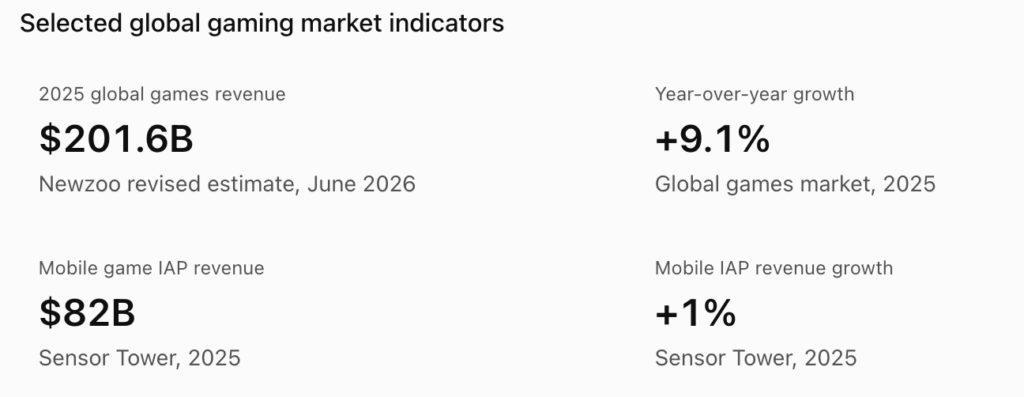
Sensor Tower reported that mobile game IAP revenue reached approximately $82 billion in 2025, an increase of 1% from the previous year. Its report also described continued emphasis on live operations, events, and intellectual property collaborations as publishers focused on monetizing existing audiences.
These figures point toward a central industry development: mobile gaming remains commercially significant, but publishers are increasingly required to extract sustainable value from existing player relationships rather than depend exclusively on download expansion.
The divergence between broader market revenue estimates and app-store IAP measurements also highlights the growing importance of understanding what each data provider includes.
Direct-to-consumer transactions, advertising revenue, alternative distribution channels, and different geographical coverage can produce materially different estimates.
For analysts and marketers, methodological transparency is essential when interpreting market performance.
8. Mobile gaming outlook: Strategic priorities for 2026 and beyond
The next phase of mobile gaming development is unlikely to be defined by a single technology or monetization model.
Instead, the industry is moving toward a more interconnected operating environment in which acquisition, product development, monetization, analytics, and community engagement influence one another.
Several strategic priorities emerge from the trends examined in this report.
Revenue diversification will become increasingly important
Publishers are likely to continue exploring combinations of advertising, in-app purchases, subscriptions, and direct-to-consumer commerce.
However, the effectiveness of each model will depend on game genre, audience characteristics, regulatory requirements, and platform policies.
Revenue diversification should therefore be approached as an economic optimization problem rather than an assumption that more monetization channels automatically produce greater profitability.
Retention will remain central to growth
As mature markets become more competitive, publishers will need to improve the economic performance of acquired users.
This places greater emphasis on onboarding, live operations, progression design, community engagement, and lifecycle marketing.
Cross-platform account systems may further expand the definition of retention by allowing publishers to evaluate player activity across connected devices.
AI will accelerate marketing experimentation
Generative AI and predictive analytics are likely to become more deeply integrated into mobile game marketing workflows.
The most meaningful competitive advantages may come from connecting these technologies with reliable first-party data, rigorous experimentation, and strong creative oversight.
Simply increasing the number of AI-generated advertising assets is unlikely to provide a durable advantage without improvements in acquisition quality.
Privacy-first measurement will shape investment decisions
Advertising measurement will continue to evolve as publishers navigate privacy requirements, platform attribution systems, and fragmented player journeys.
A combination of aggregated attribution, predictive modeling, and incrementality testing is likely to remain important for evaluating marketing effectiveness.
Emerging technologies require selective investment
Spatial computing, immersive advertising, cloud gaming, and future 6G connectivity could expand the technical possibilities of mobile entertainment.
However, their commercial maturity varies substantially.
Publishers should distinguish between technologies that can improve performance today and those that require further infrastructure development, hardware adoption, or changes in consumer behavior.
Mobile gaming trend maturity and commercial outlook
| Trend | 2026 maturity | Strategic implication |
|---|---|---|
| Hybrid-casual monetization | Established and evolving | Optimize combined advertising and IAP revenue |
| Direct-to-consumer web shops | Growing, policy-dependent | Test direct commerce and player loyalty |
| AI-assisted creative production | Rapidly developing | Increase testing efficiency with human oversight |
| Predictive LTV modeling | Established but evolving | Improve acquisition and budget allocation |
| Cross-platform progression | Established in selected games | Strengthen account-level retention |
| Community-led acquisition | Established | Develop organic discovery and engagement |
| Smartphone-based AR marketing | Available but specialized | Test interactive brand experiences |
| Headset-based spatial marketing | Early-stage | Focus on targeted experiments |
| 6G-enabled cloud gaming | Pre-commercial | Monitor longer-term infrastructure developments |
| 8K interactive mobile advertising | Speculative | Prioritize efficient creative delivery today |
MMR editorial assessment of technology and commercial maturity as of October 2026. These classifications are qualitative, not independently measured market shares or adoption rates.
9. Frequently asked questions about global mobile gaming trends
What are the biggest mobile gaming trends in 2026?
The major mobile gaming trends in 2026 include hybrid monetization, direct-to-consumer web shops, AI-assisted user acquisition, predictive lifetime value modeling, cross-platform retention, and privacy-first advertising measurement. Spatial computing and 6G are also important emerging topics, although their immediate commercial impact is more limited.
How large is the global mobile gaming market?
Mobile gaming remains the largest individual platform segment of the global games industry. Newzoo’s revised estimates put total worldwide games revenue at $201.6 billion in 2025, while Sensor Tower reported approximately $82 billion in mobile game in-app purchase revenue for the same year. These figures measure different revenue categories and should not be treated as interchangeable.
What are the latest trends in mobile game marketing and monetization?
Mobile game marketing increasingly combines automated creative testing, first-party analytics, predictive LTV models, creator partnerships, and community engagement. Monetization is also diversifying through hybrid advertising and IAP models, web shops, subscriptions, and loyalty programs.
Why are hybrid-casual games becoming more important?
Hybrid-casual games combine accessible gameplay with deeper progression and monetization systems. This allows publishers to pursue broader acquisition while creating more opportunities for repeat engagement and revenue. Sensor Tower reported 37% year-over-year IAP revenue growth for hybrid-casual games in 2024, demonstrating the model’s momentum entering 2025.
How is AI changing mobile game user acquisition?
AI is helping marketers generate creative variations, analyze campaign performance, forecast player lifetime value, and personalize selected player experiences. Its effectiveness depends on reliable data, meaningful testing, and alignment with actual gameplay.
How does cross-platform gaming improve player retention?
Cross-platform gaming can improve retention by allowing players to maintain progress, inventories, and account identities across supported devices. It also enables publishers to develop more comprehensive lifecycle marketing and measure engagement beyond a single platform.
How are spatial computing and AR redefining mobile game marketing in 2026?
Spatial computing and AR are expanding opportunities for interactive advertisements, virtual character demonstrations, location-based experiences, and immersive game previews. Smartphone-based AR offers a more accessible channel for broad experimentation, while headset-based marketing remains limited by hardware adoption and production costs.
What impact will 6G have on high-fidelity mobile gaming?
6G could eventually improve network capacity, reliability, and support for immersive applications, potentially benefiting cloud gaming and high-fidelity interactive experiences. However, mainstream commercial deployment is not expected in 2026, and improved networks will not eliminate latency entirely. Initial deployments are anticipated around 2030.
What are the most effective mobile game player retention strategies in 2026?
Effective retention strategies include optimized onboarding, regular live events, progression systems, relevant lifecycle messaging, community engagement, and cross-progression where supported. Publishers should evaluate these activities using retention cohorts, engagement metrics, lifetime value, and incremental revenue.
Will mobile gaming continue to grow beyond 2026?
Mobile gaming has opportunities for continued growth through regional expansion, direct-to-consumer monetization, cross-platform ecosystems, and improvements in mobile hardware and connectivity. However, growth is likely to remain uneven across genres and regions, and long-term performance will depend on player engagement and monetization efficiency.




Comments
Loading…