







The mobile gaming industry has moved beyond the era when simple gameplay mechanics and high-volume user acquisition were enough to sustain growth. As acquisition costs fluctuate, competition intensifies, and monetization strategies become more sophisticated, developers of hybrid-casual games face a fundamental challenge: attracting players at scale while keeping them engaged long enough to generate sustainable revenue.
One increasingly relevant solution lies within the player community itself.
User-generated content (UGC) is becoming an important component of mobile game marketing, allowing developers to turn gameplay experiences, player achievements, community challenges, and authentic recommendations into acquisition and retention assets.
For hybrid-casual games, this approach has particular value. These titles combine the accessibility of hyper-casual gaming with progression systems, deeper engagement loops, and monetization mechanics typically associated with more complex mobile games. Communicating that combination effectively requires more than a conventional gameplay advertisement.
Player-led content can help demonstrate both the immediate appeal of a game and the longer-term reasons to continue playing.
However, successfully scaling hybrid-casual mobile games through UGC requires a structured approach that connects creative production, paid user acquisition, app store optimization, community management, and monetization analytics.
This guide examines how developers and mobile marketers can build that framework, which player-led content tactics deserve priority, and how to measure their contribution to profitable growth.
1. The Evolution of Hybrid-Casual Games: Why Scaling Requires a Content Pivot
From hyper-casual simplicity to deeper player engagement
Hyper-casual games traditionally rely on straightforward mechanics, short sessions, and minimal onboarding. Their business models have generally emphasized advertising revenue, with growth driven by large installation volumes and efficient acquisition costs.
Hybrid-casual games retain the accessibility of this model while introducing additional systems designed to extend the player lifecycle.
These may include:
- Persistent progression systems, character upgrades, and unlockable content.
- In-game economies involving currencies, resources, and rewards.
- Competitive elements, leaderboards, and community challenges.
- In-app purchases alongside rewarded video, interstitial, and other advertising formats.
- More sophisticated difficulty curves and long-term retention mechanics.
The result is a product that may appeal to casual players initially but increasingly depends on sustained engagement and effective monetization.
This changes the economics of growth.
A hyper-casual campaign might emphasize an instantly understandable gameplay loop. A hybrid-casual campaign must often communicate two separate value propositions: why the game is enjoyable within the first few seconds and why players should return after their first session.
That distinction makes creative strategy especially important.
Why traditional user acquisition approaches face limitations
Performance marketing remains central to mobile game growth, but relying on a narrow selection of gameplay videos or highly polished advertisements creates several challenges.
Creative fatigue: Repeated exposure to similar advertisements can reduce engagement, particularly when campaigns target overlapping audiences.
Limited differentiation: Games featuring comparable mechanics may struggle to communicate what makes their progression systems, challenges, or player experiences distinct.
Acquisition-to-retention mismatch: Advertisements optimized exclusively for immediate installs may attract users who are interested in the advertised mechanic but not the broader game experience.
Production constraints: Maintaining a continuous supply of new advertising concepts can become resource-intensive as campaigns expand across markets, audiences, and platforms.
These challenges do not mean conventional creatives have become ineffective. Instead, they highlight the need for a broader creative portfolio that includes content grounded in actual player experiences.
Why player-led content fits the hybrid-casual model
UGC allows marketers to showcase different stages of the player journey rather than repeatedly promoting a single mechanic.
A short clip showing an unexpected failure might attract attention. A player demonstrating a successful upgrade strategy could communicate progression depth. A community challenge might introduce competitive motivation, while a testimonial could explain why someone continues playing after several weeks.
Together, these formats provide a more complete picture of the product.
For hybrid-casual developers, the opportunity is to use player-led content not simply to acquire more users, but to acquire users whose expectations align with the game’s retention and monetization systems.
2. Why Player-Led Content Matters for Hybrid-Casual Scaling
Social proof helps explain increasingly complex games
Social proof refers to the tendency to use other people’s experiences and behavior as signals when evaluating an unfamiliar product.
In mobile gaming, player-led content can provide this context through authentic demonstrations of gameplay, reactions, strategies, and progression.
For example, consider two advertisements promoting a hybrid-casual puzzle game.
The first presents a polished sequence of puzzle-solving mechanics, accompanied by promotional messaging.
The second shows a real player struggling with a difficult level, discovering an upgrade strategy, and eventually completing the challenge.
Both may generate interest, but the second offers additional information about the game’s learning curve, progression, and sense of achievement.
This is particularly useful when a game includes mechanics that are difficult to communicate through a short traditional advertisement.
Importantly, UGC does not automatically create trust. Its credibility depends on whether the experience appears genuine, whether sponsorship is disclosed where required, and whether the advertised gameplay accurately reflects the product.
The economics of UGC versus studio-produced creative
Player-led content can expand creative production capacity without requiring every concept to originate from an internal production team.
| Dimension | Traditional studio creative | Player-led UGC |
|---|---|---|
| Production | Centrally planned and produced | Sourced from players, creators, or communities |
| Creative variety | Dependent on internal concepts | Draws from diverse gameplay experiences |
| Authenticity | Often polished and promotional | Can reflect real player perspectives |
| Scalability | Limited by production resources | Expandable through creator and community programs |
| Main challenge | Production cost and creative fatigue | Quality control, permissions, and consistency |
| Best application | Controlled product demonstrations | Social proof, reactions, tutorials, and community narratives |
UGC is not necessarily cheaper in every situation. Creator fees, usage rights, moderation, editing, incentives, and campaign management can create substantial costs.
Its economic advantage comes from the potential to generate more creative hypotheses and identify effective concepts before committing larger production budgets.
Connecting casual acquisition with long-term monetization
Hybrid-casual monetization often combines advertising revenue with in-app purchases.
This makes player quality particularly important.
An advertisement that generates inexpensive installs but attracts users who abandon the game after one session may deliver less value than a creative that produces a higher CPI but attracts players who engage with progression systems.
Player-led content can support this distinction by highlighting experiences associated with longer-term engagement.
Examples include a player explaining why a particular upgrade changed their strategy, demonstrating a difficult level after multiple attempts, or comparing their early-game performance with their progress after several days.
These narratives introduce players to the game’s longer-term value before installation.
The objective is not to imply that UGC automatically improves lifetime value. Rather, it is to test whether progression-focused content attracts cohorts with stronger retention and monetization characteristics.
3. Five Player-Led Content Tactics for Scaling Hybrid-Casual Games
The following five tactics can form the foundation of a repeatable UGC growth framework.
Tactic 1: Creator Whitelisting and Partnership Ads
Creator whitelisting, often referred to more broadly as creator-authorized advertising, allows advertisers to promote content through a creator’s identity or authorized post, subject to the advertising platform’s available permissions and tools.
On platforms such as TikTok and Meta, creator partnership advertising can help developers distribute creator-led gameplay content beyond the creator’s organic audience.
For hybrid-casual games, this can be especially useful when creators specialize in puzzle games, mobile strategy, gaming challenges, or short-form entertainment.
How to execute
- Identify micro-creators whose audiences align with the game’s target players.
- Provide access to the game and a creative brief that explains the core mechanics without scripting every reaction.
- Request multiple content angles, such as first impressions, progression demonstrations, and challenge-based videos.
- Obtain the necessary permissions for paid promotion, editing, and usage duration.
- Test the creatives against conventional gameplay ads using comparable campaign conditions.
- Scale the strongest concepts based on downstream acquisition and monetization performance.
A developer might recruit ten creators to produce three different videos each, generating 30 initial creative assets.
Rather than promoting every asset equally, the UA team can test a representative selection, identify successful formats, and commission additional variations.
Key consideration: Creator follower counts should not be the primary selection criterion. Audience relevance, content quality, gameplay communication, and historical engagement are often more useful screening factors.
Tactic 2: Incentivize In-Game Content Capture
One of the most direct ways to generate player-led content is to make memorable gameplay moments easier to capture and share.
Hybrid-casual games frequently contain situations suitable for short-form content, including unexpected victories, difficult challenges, rare unlocks, unusual combinations, and competitive achievements.
Developers can build content-sharing opportunities around these moments.
Practical implementation
Start by identifying the events most likely to produce an emotional response.
Examples include completing a particularly difficult level, unlocking a rare item, defeating a challenging opponent, or reaching a meaningful progression milestone.
Next, reduce friction in the capture process.
Depending on the game and platform, this might involve a replay feature, shareable achievement cards, screenshot prompts, or a post-level sharing interface.
Rewards can encourage participation, but incentive design requires care.
For instance, developers may offer an optional in-game cosmetic reward for participating in a community event. However, rewards should not be conditional on positive reviews, misleading endorsements, or other activity that violates platform policies.
A useful implementation sequence is:
- Identify three to five high-emotion gameplay events.
- Add a nonintrusive capture or sharing option.
- Test whether players use the feature organically.
- Introduce optional community participation incentives.
- Measure sharing frequency, referral behavior, and downstream acquisition.
The primary goal is to create an environment where content creation becomes a natural extension of gameplay rather than an interruption.
Tactic 3: Community Challenges and Hashtag Campaigns
Community challenges can transform isolated player experiences into recurring content formats.
Instead of asking players to share generic gameplay clips, developers can introduce a specific challenge that creates a recognizable theme.
For example, a hybrid-casual game might launch a weekly challenge encouraging players to complete a difficult level using an unconventional strategy.
Participants could share their attempts on TikTok, YouTube Shorts, Instagram Reels, or relevant community channels.
A branded hashtag can help organize submissions, although hashtags alone do not guarantee algorithmic distribution.
Building an effective challenge
A challenge should be understandable, achievable, and easy to reproduce.
It should also connect to a mechanic that accurately represents the game.
Potential formats include speedrun challenges, unusual build combinations, no-upgrade completion attempts, or weekly progression milestones.
The campaign can then follow a recurring cycle:
Launch challenge
Collect entries
Analyze results
Feature standout content and refine the next challenge
Community teams can feature standout submissions through official channels, with the creators’ permission.
Over time, this approach can establish a recurring content pipeline while giving existing players additional reasons to engage.
For paid UA, developers can evaluate whether selected challenge videos outperform standard advertisements. For retention, they can examine whether challenge participants return more frequently than comparable nonparticipants, accounting for differences in initial engagement.
Tactic 4: Use Player-Generated Content to Inspire Playable Ads
Playable advertisements give potential users a limited opportunity to interact with a game mechanic before installation.
UGC can help developers identify which mechanics, challenges, and emotional moments deserve representation in these interactive formats.
Rather than creating playable concepts exclusively from internal assumptions, UA and creative teams can study player behavior and community content.
For example, suppose several popular player videos demonstrate a surprising combination of upgrades that produces an unusually powerful result.
That interaction could inspire a playable advertisement centered on the same mechanic.
An execution framework
Step 1: Identify recurring player moments. Review community submissions, organic videos, and creator content for frequently repeated gameplay interactions.
Step 2: Evaluate creative potential. Prioritize mechanics that are visually understandable, interactive, and representative of the real game.
Step 3: Develop playable prototypes. Translate the selected mechanic into a short interactive experience.
Step 4: Test against existing formats. Compare engagement, installation conversion, retention, and monetization outcomes.
Step 5: Refine the experience. Use performance data to determine whether the mechanic attracts relevant users.
A critical distinction is that a playable ad inspired by UGC is not necessarily UGC itself. The value lies in using actual player behavior to inform creative development.
Tactic 5: Narrative-Driven Player Testimonials
Progression is one of the defining features separating many hybrid-casual games from traditional hyper-casual titles.
That progression can also provide a compelling storytelling framework.
Instead of focusing exclusively on individual gameplay moments, developers can invite players to document how their experience changes over time.
A player might describe their first difficult level, the upgrade that helped them progress, and the strategies they developed after several sessions.
These stories communicate a broader value proposition: the game offers reasons to return.
Useful testimonial formats
Before-and-after progression: A player compares their initial gameplay with their current abilities or unlocked features.
Strategy discovery: A player explains how they overcame a difficult challenge.
Personal achievement: A player shares a meaningful milestone or accomplishment.
Community participation: A player describes joining a challenge or competing with friends.
These formats can be distributed organically, adapted into paid advertisements with appropriate permissions, or incorporated into community marketing campaigns.
The strongest testimonials generally focus on specific experiences rather than generic praise.
For hybrid-casual games, a detailed explanation of a player’s progression may be more informative than a broad statement that the game is entertaining.
4. Integrating UGC into Paid User Acquisition and App Store Optimization
Creating player-led content is only the first stage. To support scalable growth, developers need to integrate UGC into their existing performance marketing infrastructure.
This means connecting creative production with audience targeting, campaign experimentation, attribution, and app store conversion optimization.
A/B testing UGC on Meta and TikTok
UGC performance should be evaluated through controlled experiments rather than assumptions about authenticity or engagement.
For hybrid-casual games, the most useful experiments compare distinct creative approaches while minimizing differences in audience composition, bidding strategy, geography, and campaign objectives.
A practical testing matrix might include:
| Creative variation | Primary hypothesis | Key metrics |
|---|---|---|
| Raw player gameplay | Authentic footage increases interest | CTR, CPI |
| Creator reaction video | Personal reactions improve engagement | CTR, install CVR |
| Progression testimonial | Progression-focused users retain longer | D7 retention, D30 ROAS |
| Community challenge | Competitive content encourages installs | CPI, D7 engagement |
| Studio-produced gameplay | Polished demonstrations improve comprehension | Install CVR, CPI |
Campaigns should initially receive sufficient budget to collect meaningful performance data without prematurely concentrating spend on one creative.
On Meta, developers can test creator partnership ads alongside conventional video creatives. TikTok offers opportunities to evaluate creator-led content through its advertising ecosystem, including authorized organic posts where eligible.
The central question should not simply be which video generates the most clicks.
Instead, marketers should determine which creative attracts players who continue engaging with the game and contribute to its monetization model.
How UGC supports App Store Optimization
App Store Optimization (ASO) and paid user acquisition are closely connected through the installation journey.
An advertisement may generate interest, but the product page must reinforce the expectations established by the creative.
If a player clicks on an advertisement highlighting character progression, for example, the app store listing should accurately demonstrate that progression.
UGC can inform ASO decisions in several ways.
First, developers can analyze player-generated videos to identify mechanics that audiences find interesting. These insights can influence screenshot selection, preview video concepts, and product page messaging.
Second, authentic player language can reveal how audiences describe the game’s mechanics, challenges, and progression systems.
Third, community feedback can help identify potential mismatches between marketing promises and actual gameplay.
However, developers must respect platform-specific creative requirements. Apple and Google maintain distinct policies governing screenshots, previews, promotional assets, and store listing experiments. Player footage cannot simply be reused in every store asset without considering these rules and obtaining the necessary permissions.
Developers can evaluate creative hypotheses through tools such as Apple’s Product Page Optimization and Google’s Play Console store listing experiments, where applicable.
When should developers scale a successful UGC creative?
A high-performing creative should not automatically receive a large budget increase after generating a few inexpensive installs.
The decision to scale should account for acquisition efficiency, statistical uncertainty, retention, monetization, and creative durability.
A practical process involves three stages.
Stage 1: Creative validation. Establish whether the UGC asset generates competitive click-through rates, installation conversion rates, and CPI relative to existing campaigns.
Stage 2: Cohort validation. Examine early retention, session frequency, and monetization indicators. Where data is available, compare D7 ROAS and predicted LTV with established benchmarks.
Stage 3: Controlled budget expansion. Increase spending incrementally while monitoring whether performance deteriorates as delivery expands to broader audiences.
There is no universal percentage by which budgets should increase. The appropriate pace depends on campaign learning dynamics, audience size, conversion volume, attribution reliability, and the game’s unit economics.
Developers should also create variations of successful concepts rather than relying indefinitely on a single video.
A winning player testimonial, for instance, might produce several new versions featuring different opening hooks, progression milestones, or creator perspectives.
5. Measuring Success: KPIs for Player-Led Scaling Campaigns
The effectiveness of UGC should be evaluated through its contribution to business outcomes rather than content engagement alone.
For hybrid-casual games, this requires connecting acquisition performance with retention and monetization data.
Acquisition efficiency: CPI and conversion rates
Cost per install remains a useful initial indicator of campaign efficiency.
\[ \text{CPI}=\frac{\text{Advertising Spend}}{\text{Attributed Installs}} \]
If a campaign spends $5,000 and generates 2,000 attributed installs, its CPI is $2.50.
However, CPI alone does not establish whether those installs are profitable.
A player acquired for $1.50 who generates $0.80 in lifetime revenue may be less valuable than a player acquired for $2.50 who generates $5.00.
For that reason, CPI should be interpreted alongside retention, revenue, and acquisition payback.
Evaluating ROAS and LTV
Return on ad spend measures attributed revenue relative to advertising investment.
\[ \text{ROAS}=\frac{\text{Attributed Revenue}}{\text{Ad Spend}}\times100 \]
Hybrid-casual developers should evaluate ROAS across relevant cohort windows, such as D7, D30, and D90, depending on the game’s monetization profile.
For titles using both in-app advertising and in-app purchases, revenue analysis should incorporate both sources where measurement allows.
Lifetime value (LTV) provides a broader view of expected player revenue over a defined lifetime or forecast horizon.
A UGC campaign may appear less efficient during the initial acquisition period but produce stronger longer-term economics if it attracts users who engage more deeply with progression systems.
The opposite is also possible. Entertaining player videos may generate inexpensive installs without attracting players interested in the actual game.
An illustrative campaign comparison
The following hypothetical example shows why evaluating UGC through CPI alone can lead to incomplete conclusions.

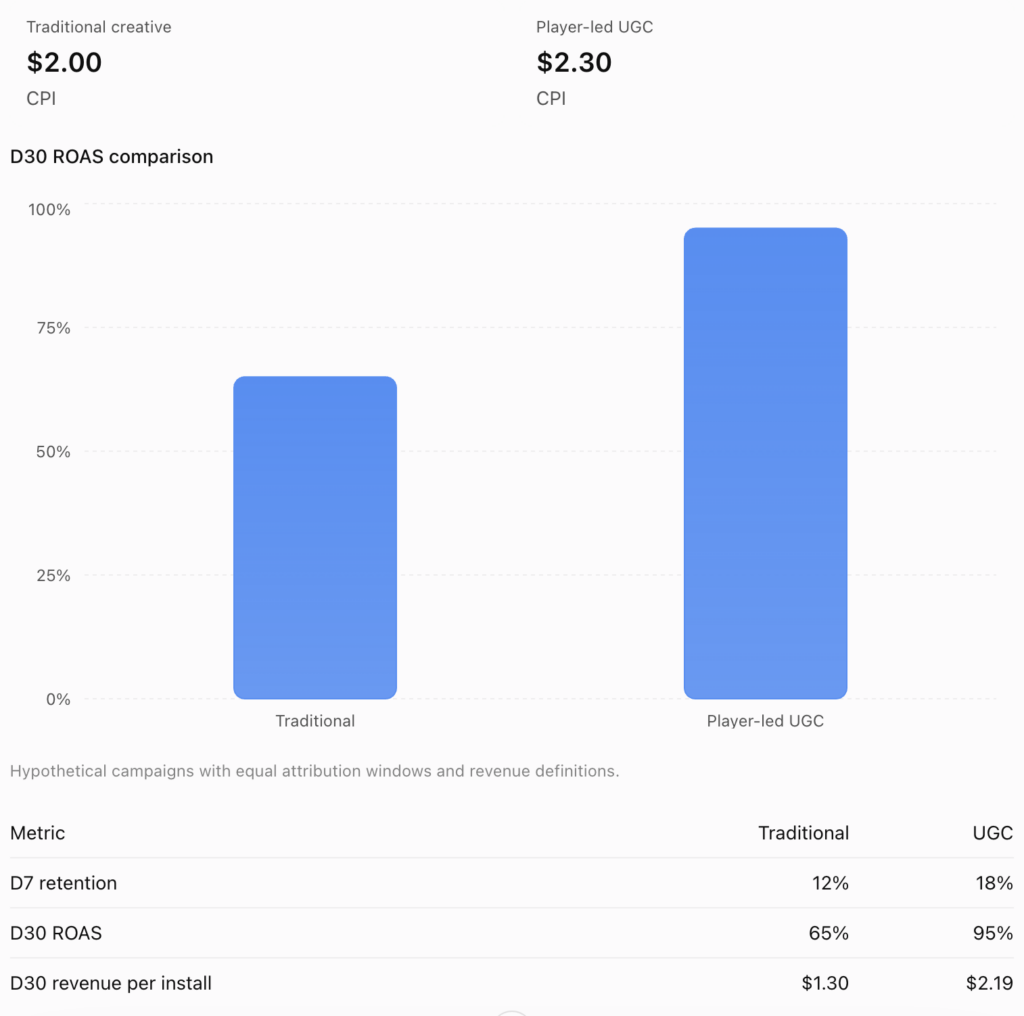
Hypothetical campaigns with equal attribution windows and revenue definitions.
In this scenario, the UGC campaign has a higher CPI but generates stronger D30 revenue recovery and retention.
The example illustrates why developers should optimize toward cohort economics instead of selecting creatives based exclusively on installation cost.
Neither campaign has necessarily achieved profitability at D30. A complete evaluation would also account for revenue beyond the observation window, platform fees where relevant, and other costs.
Measuring qualitative community signals
Not every useful UGC metric is financial.
Developers can also analyze comments, community participation, content sentiment, and recurring player feedback.
Useful questions include whether players understand the advertised mechanics, which progression features they discuss, and whether community challenges generate sustained participation.
Sentiment analysis can help categorize feedback, but automated sentiment scores should be supplemented with human review. Sarcasm, gaming terminology, and mixed reactions can reduce classification accuracy.
Combining quantitative acquisition data with qualitative community feedback provides a more complete picture of how player-led content influences growth.
6. Future-Proofing UGC Strategies with AI and Automation
As developers expand creator partnerships and community campaigns, managing the volume of content becomes a significant operational challenge.
Artificial intelligence and automation can help organize this process, although they do not replace the need for editorial judgment, player consent, and creative experimentation.
Using AI to identify high-potential player moments
AI-assisted workflows can help creative teams review large libraries of gameplay footage and identify potentially useful clips.
Depending on the tools available, developers can automate tasks such as video transcription, scene classification, subtitle generation, aspect-ratio adaptation, and initial content tagging.
For example, a creative team might categorize submitted videos according to gameplay mechanic, player reaction, progression milestone, and video duration.
The team can then review the most relevant clips for potential campaign use.
AI can also help generate alternative hooks or editing variations for testing.
However, AI-generated changes should not misrepresent gameplay or create fabricated player testimonials. The value of authentic UGC depends partly on the relationship between the content and the actual player experience.
Building an automated creator content pipeline
Creator management platforms can reduce the administrative work associated with recruiting creators, distributing briefs, collecting submissions, and tracking deliverables.
A structured pipeline might include:
- Creator discovery: Identify relevant creators based on audience fit and content style.
- Brief distribution: Communicate gameplay features, deliverables, disclosure requirements, and usage rights.
- Content submission: Collect original video files and campaign metadata.
- Quality review: Verify accuracy, permissions, technical specifications, and brand suitability.
- Creative testing: Deploy approved content through appropriate advertising channels.
- Performance feedback: Share aggregated insights with creators to inform future iterations.
Developers should maintain a centralized record of creative assets, usage permissions, campaign results, and expiration dates.
This reduces the risk of reusing content beyond its licensed period and makes it easier to connect creative concepts with performance outcomes.
7. Building a 90-Day Player-Led Growth Plan
For studios beginning to integrate UGC into their hybrid-casual marketing strategy, a phased rollout can reduce operational complexity.
The following framework is an illustrative implementation plan rather than a guaranteed growth formula.
- Days 1–30: Establish the baselineAudit existing creatives, identify shareable gameplay moments, recruit an initial creator group, and establish baseline CPI, retention, and ROAS metrics. Define usage-rights procedures and campaign measurement conventions.
- Days 31–60: Test creative hypothesesLaunch creator-led videos, progression testimonials, and a limited community challenge. Test selected formats against existing paid UA creatives while monitoring early cohort performance.
- Days 61–90: Expand validated conceptsScale creatives with promising downstream economics, produce variations, evaluate store listing alignment, and establish a recurring content collection and reporting process.
The objective after 90 days should be a repeatable decision-making process, not simply a larger library of videos.
Teams should be able to identify which player stories generate interest, which content formats attract valuable users, and which creative concepts deserve further investment.
Frequently Asked Questions About Scaling Hybrid-Casual Games with UGC
What are the best tactics for scaling hybrid-casual mobile games using player-led content?
The most actionable tactics include creator-authorized advertising, in-game sharing features, community challenges, UGC-inspired playable ads, and progression-focused player testimonials. Developers should test these formats through paid user acquisition campaigns and evaluate their impact on CPI, retention, ROAS, and LTV before increasing budgets.
How does UGC improve user acquisition for hybrid-casual games?
UGC can introduce gameplay through real player experiences, demonstrate progression mechanics, and provide social proof. It can also diversify advertising creatives and help developers identify messages that resonate with potential players. Whether it improves acquisition efficiency depends on creative quality, audience targeting, campaign execution, and measurement.
Is UGC more cost-effective than traditional mobile game advertising?
UGC can reduce reliance on internally produced creative assets and increase the number of concepts available for testing. However, creator fees, editing, licensing, moderation, and campaign management must be included when comparing costs. The most meaningful comparison is the total cost of acquiring and monetizing valuable players, rather than video production expenses alone.
Can player-generated content improve hybrid-casual game retention?
Player-generated content may help attract users whose interests align with the game’s progression and engagement mechanics. Community challenges can also encourage existing players to participate in recurring activities. Developers should validate any retention improvement through cohort analysis or controlled experiments rather than assuming that UGC causes stronger engagement.
How should developers measure the success of UGC campaigns?
Developers should track creative engagement, click-through rate, installation conversion rate, CPI, D1/D7/D30 retention, ROAS, and LTV. They should also monitor content participation, player sentiment, and creative fatigue. Hybrid-casual games that combine advertising and in-app purchases should evaluate revenue from both monetization sources.
Which platforms are best for hybrid-casual UGC marketing?
TikTok, Instagram Reels, and YouTube Shorts are useful channels for distributing short-form gameplay content. Meta and TikTok advertising products can support paid creator-led campaigns, subject to platform requirements. Discord, Reddit, and other communities can support player discussion and challenges, provided developers respect community rules and avoid unsolicited promotion. Platform selection should depend on audience behavior and measurable acquisition outcomes.
How can small hybrid-casual studios start using UGC with limited budgets?
Small studios can begin by identifying shareable gameplay moments, engaging existing players, and testing a limited number of creator partnerships. Rather than launching a large campaign immediately, they can validate a few creative concepts and reinvest in formats that demonstrate promising acquisition and retention results.
Can AI-generated content replace authentic player-led UGC?
AI can assist with editing, categorization, subtitles, and creative variations, but it should not be used to fabricate player experiences or endorsements. For developers seeking to build trust through UGC, authentic gameplay and transparent creator relationships remain important.
Final Thoughts: Player-Led Growth Needs to Connect Acquisition with Monetization
Scaling hybrid-casual mobile games requires more than increasing advertising spend or producing additional gameplay videos.
As hybrid-casual titles combine accessible mechanics with deeper progression and monetization systems, their marketing strategies must communicate both immediate entertainment value and longer-term engagement opportunities.
Player-led content provides a way to address that challenge through authentic gameplay demonstrations, creator partnerships, community participation, and progression-focused storytelling.
Its effectiveness, however, depends on execution.
Developers need clear content permissions, repeatable creative testing processes, reliable attribution, and performance measurement that extends beyond installation volume.
The most useful UGC strategies are those that connect player experiences with measurable acquisition, retention, and revenue outcomes.
For hybrid-casual studios, that means treating user-generated content as part of a broader growth framework rather than an isolated social media initiative.
Looking to optimize your hybrid-casual growth? Subscribe to the Mobile Marketing Reads newsletter for weekly insights into the latest user acquisition tactics, mobile game monetization strategies, and UGC frameworks.





Comments
Loading…