



 Maya Robertson
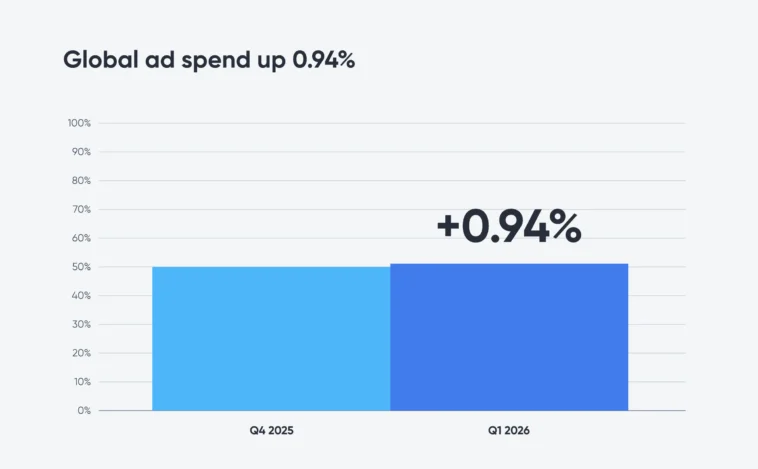
Global mobile advertising spend increased by 0.94% quarter over quarter in Q1 2026, marking a significant departure from the seasonal slowdown that typically follows the holiday quarter, according to Singular’s Q2 2026 Quarterly Trends Report.
Historically, the first quarter has seen a notable pullback in advertiser budgets after the peak shopping season. In Q1 2025, global mobile ad spend declined 7.4% compared to the previous quarter. This year’s modest increase suggests that advertisers maintained investment levels despite seasonal headwinds, signaling greater resilience in the mobile advertising market.
While overall spending remained stable, the report points to major shifts in where advertisers allocated their budgets. Utility apps recorded the largest increase, with global ad spend surging 943% quarter over quarter, fueled largely by the rapid growth of AI-powered applications. Education followed with a 65.9% increase, while Entertainment spending climbed 50.1% to surpass a new quarterly milestone. Finance apps also attracted significantly more investment, posting 35.3% growth as fintech companies continued expanding user acquisition efforts.
The gains in these sectors offset declines across several categories that traditionally receive elevated investment during the holiday period. Ad spend on On-demand apps fell 30.5%, while E-commerce experienced the sharpest contraction, dropping 38.7% as retailers scaled back acquisition campaigns following year-end promotions.
Platform dynamics also shifted during the quarter. Although total mobile ad impressions remained relatively stable, iOS impressions increased 13.3%, while Android impressions declined 6.4%, resulting in a larger share of available inventory on Apple’s platform.
Those changes influenced advertising costs across both ecosystems. iOS CPM declined 10.5% as inventory expanded, whereas Android CPM rose 7.3% amid tighter supply. Cost per install followed a similar pattern, with Android CPI increasing 15.1% to $0.76, while iOS CPI edged down 1.1% to $3.03.
Overall advertiser investment reflected these platform trends. iOS ad spend rose 1.43% during the quarter, outpacing Android, which recorded a 0.43% increase.
The report also highlights changes among advertising platforms. Facebook emerged as the largest net gainer of mobile advertising spend during Q1, overtaking TikTok, which recorded flat quarter-over-quarter growth for the first time after several quarters of expansion. Moloco ranked as the second-largest beneficiary of shifting advertiser budgets.
Based on billions of dollars in advertising spend, trillions of ad impressions, billions of installs, and tens of billions of clicks, Singular concludes that the first quarter of 2026 was defined less by overall market expansion than by a significant reallocation of advertising budgets. As investment shifted toward AI-driven utilities and other high-growth app categories, global mobile ad spend remained resilient despite the seasonal slowdown that has historically characterized the beginning of the year.



Comments
Loading…