



 Maya Robertson
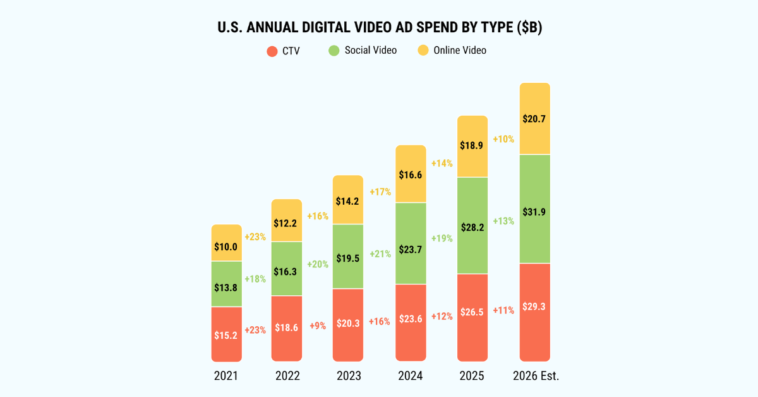
New data from the Interactive Advertising Bureau indicates a shift in digital video investment patterns, with social video expected to grow at a faster rate than connected TV (CTV) for the first time. The trend reflects changing advertiser priorities as platforms, formats, and measurement capabilities evolve.
According to the IAB’s latest report, U.S. digital video ad spending is projected to exceed $80 billion in 2026, representing an 11% year-over-year increase and accounting for more than 60% of total TV and video ad spend. Within that total, social video is forecast to grow by 13%, outpacing CTV’s expected 11% growth rate.
The acceleration of social video investment is being driven by a combination of audience behavior and platform capabilities. Increased time spent watching video across social platforms is contributing to higher engagement levels, while advertisers are reallocating budgets to align with these consumption patterns. Media buyers report that social video now represents a significant share of total ad spend, particularly among brands prioritizing performance-driven strategies.
At the same time, the report highlights the growing influence of artificial intelligence across the video advertising ecosystem. AI is increasingly embedded in campaign planning, creative production, and measurement, enabling advertisers to scale campaigns more efficiently and optimize performance in real time. Smaller advertisers are using AI tools to reduce production costs and accelerate creative output, while larger organizations are applying AI to inventory discovery and campaign optimization.
The rise of the creator economy is also contributing to the shift. Social platforms are combining brand awareness and performance marketing within a single environment, supported by influencer content and user-generated media. This integration is encouraging brands to consolidate budgets that were previously split across channels, including traditional television and CTV.
Despite slower relative growth, CTV continues to attract investment, particularly through programmatic buying and improved targeting capabilities. However, the report suggests that targeting precision has now overtaken content quality as the primary factor influencing media buying decisions, especially among small and mid-sized advertisers.
Operational factors are also influencing budget allocation. Faster production cycles, lower costs, and the ability to iterate creative quickly make social video more adaptable compared to CTV, where production timelines and costs remain higher.



Comments
Loading…