






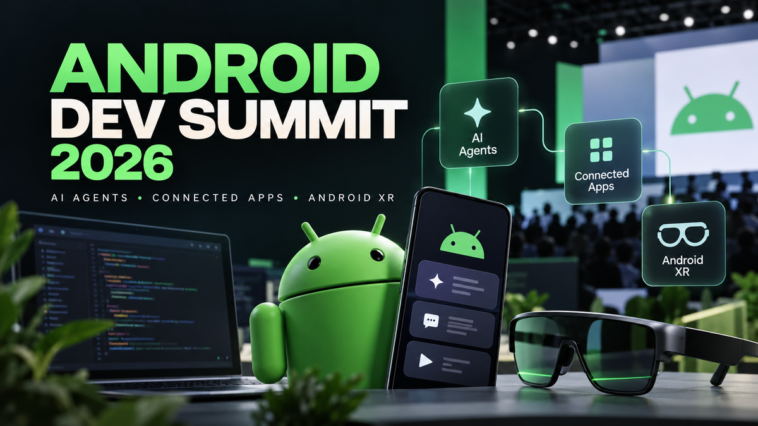
Google’s Android Dev Summit 2026 brought a series of announcements spanning AI-assisted software development, app discovery, on-device intelligence, performance optimization, and extended reality. The updates reflect a broader shift in Google’s Android strategy, with AI agents becoming increasingly integrated into both the development process and the ways users interact with applications.
Among the most significant developments were the stable release of Android Studio Rabbit 2 with support for more than 40 coding agents, the introduction of the Connected Apps Platform for integrating application services with Gemini and Google Search, and new APIs for building AI-powered experiences directly into Android apps. Google also announced improvements to Jetpack Compose, Android CLI, app performance tools, and Android XR development.
For Android developers, the announcements introduce new options for building, testing, and maintaining applications. For mobile marketers and publishers, Google’s expanding AI ecosystem could eventually influence app discovery, user engagement, and the role of traditional application interfaces.
Android Studio Rabbit 2 brings more than 40 AI coding agents into development workflows
Google released Android Studio Rabbit 2 to the stable channel, introducing Bring Your Own Agent (BYOA), which allows developers to integrate more than 40 coding agents compatible with the Agent Client Protocol (ACP).
Supported options include Claude Agent, OpenAI Codex, Junie, and Google Antigravity. Rather than requiring developers to rely on a single AI assistant, the integration enables teams to select agents based on their existing workflows, technical requirements, and preferred AI providers.
These agents can access Android Studio capabilities including the Android Emulator, build systems, Logcat, and project-aware development tools. This allows them to assist with tasks beyond code generation, including troubleshooting, application testing, and navigating complex Android projects.
The release also introduces Change Review, an AI-assisted code review feature that examines pending changes and identifies potential issues. Developers can request explanations of modifications, review generated code, and ask agents to address identified problems.
Google also introduced Android Bench 2.0, a benchmarking system designed to evaluate AI models and agent configurations on extended Android development tasks. Unlike evaluations that focus primarily on code generation, Android Bench assesses whether solutions function correctly while also considering execution time and cost.
The changes reflect Google’s effort to make Android Studio compatible with a wider range of AI development tools while maintaining access to platform-specific debugging, testing, and optimization capabilities.
Android CLI expands AI-assisted testing and performance optimization
Google extended Android CLI with capabilities that allow developers and AI agents to build, deploy, inspect, and test applications outside the traditional Android Studio interface.
One addition is remote physical-device testing through Android Device Streaming, powered by Firebase. Developers can provision devices from Google’s infrastructure and interact with them through Android CLI, allowing automated workflows and continuous integration systems to test applications on actual hardware.
Google also introduced the ability to render Jetpack Compose previews directly from the terminal. Through the android preview command, developers and agents can visually inspect interface changes without launching Android Studio or deploying an application to an emulator.
According to Google’s internal testing, agents using the preview command completed UI development tasks 77% faster while consuming up to three times fewer tokens. These figures reflect Google’s own testing rather than independently verified results.
The company also expanded performance analysis through Perfetto system tracing, allowing developers to investigate startup delays, interface rendering problems, and background activity. Additional analysis tools can examine application bundles and libraries for optimization issues.
More than 30 official Android development skills, covering over 20 technical areas, are now available to help AI agents perform specialized tasks involving security, permissions, Compose performance, and other Android-specific requirements.
Official Android CLI plugins for Claude Code and Codex were also introduced, alongside expanded integrations for Google Antigravity.
Connected Apps could introduce another path to Android app discovery
One of the summit’s most consequential announcements for the mobile business ecosystem was Google’s Connected Apps Platform, designed to make application services accessible through AI-powered experiences, including Gemini and Google Search.
The platform allows developers to expose supported application capabilities using Android MCP or remote MCP. Developers can prototype integrations through Gemini developer mode and register for the Google Connected Console preview program when preparing production integrations.
The approach introduces a potential alternative to conventional application interactions. Instead of navigating directly to an app and manually completing a series of steps, users could access certain services through an AI assistant that connects to the application’s functionality.
Google also confirmed that AppFunctions, Android’s unified tool-calling API, has entered beta. AppFunctions allows developers to expose application functions that can be invoked by compatible on-device or system AI agents.
These developments could eventually affect how users discover and interact with digital services. For mobile marketers, the possibility of AI assistants connecting users directly to application functionality raises questions about how traditional app acquisition and engagement strategies may evolve.
However, Connected Apps remains in preview, and Google has not established that the platform will deliver measurable improvements in app installs, user acquisition costs, conversion rates, or retention. Its commercial significance will depend on developer participation, user adoption, integration requirements, and future measurement capabilities.
Gemini Nano 4 and A2UI introduce new approaches to in-app AI experiences
Google also announced new APIs designed to help developers integrate AI agents into Android applications.
The ML Kit Agentic API, currently in alpha, uses Gemini Nano 4 to support on-device agent functionality. It can manage function execution, maintain conversation history, coordinate agent workflows, and apply automated safeguards.
The API is intended to simplify the technical work involved in building certain agent-driven application features, reducing the need for developers to implement every part of the orchestration process independently.
Another addition is A2UI for Jetpack Compose, also available in alpha. The technology allows AI agents to generate interactive interfaces using an application’s existing native UI components.
Instead of returning only text-based responses, an AI agent could provide interactive controls tailored to a user’s request. This introduces the possibility of application experiences in which interfaces adapt dynamically to the tasks users want to complete.
For mobile product teams, such capabilities could eventually influence onboarding, feature accessibility, and user engagement. However, the technology remains experimental, and its practical effects on product performance have yet to be established.
Jetpack Compose, Navigation 3 and adaptive layouts receive updates
Google announced several updates to Android’s interface development framework, with a focus on supporting applications across smartphones, foldables, tablets, laptops, and other device categories.
Navigation 3 version 1.2 is now stable, adding deep-link support and improvements to predictive-back navigation. Meanwhile, the forthcoming stable release of Jetpack Compose 1.13 will introduce additional interface capabilities, including Grid and Flexbox adaptive layouts, Progressive Blur, and Formatted Text.
Google also introduced AppState in alpha, extending Compose’s reactive programming model into application state management. The technology is intended to help developers maintain consistent application state across configuration changes and different device layouts.
The company expanded its Compose adaptive development skill to help AI agents identify and implement desktop-oriented interface improvements, including keyboard shortcuts, pointer interactions, hover states, tooltips, and navigation adjustments.
The skill also supports foldable-specific optimizations, such as tabletop layouts for camera and media applications.
Google indicated that Google Play will pay closer attention to how applications and games perform on foldable devices in 2027, with additional opportunities to highlight adaptive experiences. The company said further details about store requirements would be announced later in 2026.
For developers and publishers, these updates place greater emphasis on delivering consistent application experiences across multiple screen sizes rather than optimizing exclusively for conventional smartphones.
Google expands app quality, security and performance tools
Beyond AI integration and interface development, Android Dev Summit introduced additional tools for improving application quality and reducing development complexity.
Android Studio’s XML-to-Compose Migration Assistant, available in the Canary channel, can help developers convert existing XML-based interfaces into Jetpack Compose. The assistant can examine layouts, propose migration plans, and update related application logic.
Google also expanded memory diagnostics through Firebase Crashlytics, including early-access capabilities for collecting heap dumps associated with out-of-memory crashes and Android 17 Memory Limiter Kills.
Additional improvements include memory-related reporting in Android vitals, R8 configuration analysis for application optimization, and recomposition tracing in Jetpack Compose 1.13 to help developers identify the causes of unnecessary interface updates.
Google introduced Lightbuild as an early preview of a declarative build system that uses YAML-based configuration. The technology is designed to make build configurations easier for developers and AI agents to interpret and modify.
However, Google recommends using Lightbuild primarily for new or experimental projects while continuing to rely on Gradle and the Android Gradle Plugin for production applications.
Security and compliance were another focus. New Android development skills can inspect application code, permissions, and intent handling for potential security problems. The Play Policy Insights skill can also help developers review applications against Google Play policies and examine Data safety declarations before submission.
These capabilities could help developers identify issues earlier in the release process, although they do not replace Google’s formal app review or guarantee compliance with Play policies.
Android XR development advances as Google and XREAL introduce AURA
Android XR was another major focus of the summit, with Google and XREAL announcing the launch of XREAL AURA, described by Google as the first wired XR glasses powered by Android XR.
Alongside the hardware announcement, Google confirmed that several core Android XR development tools had reached stable status.
These include Jetpack XR SDK components such as Jetpack SceneCore, ARCore for Jetpack XR, and XR Runtime, providing developers with production-oriented APIs for building spatial experiences.
Android Studio’s XR emulators are also stable, allowing developers to test applications for XR glasses, audio glasses, and display glasses without requiring physical hardware.
Google additionally released a stable version of Android XR Engine Hub, providing development and performance-analysis workflows for projects built using Unity, Godot, and Unreal Engine.
Expanded geospatial APIs allow developers to anchor digital content to real-world locations, supporting new possibilities for location-aware spatial experiences.
For gaming studios and application publishers, the expanded tooling could lower some of the technical barriers to experimenting with spatial computing. However, broader commercial adoption will depend on hardware availability, consumer demand, and the development of sustainable application use cases.
What Android Dev Summit 2026 means for developers and mobile marketers
Taken together, Google’s announcements indicate a shift toward an Android ecosystem in which AI agents play a greater role in both application development and user interaction.
For developers, the immediate changes are practical. Android Studio’s broader agent compatibility, expanded command-line tools, automated code reviews, and performance diagnostics could help teams streamline development and maintenance. At the same time, the introduction of new agentic APIs creates additional technical considerations around security, reliability, and user experience.
For mobile marketers, Connected Apps represents one of the developments worth monitoring. If AI assistants become an additional way for users to access application services, developers and publishers may eventually need to reconsider how app discovery, engagement, and conversion are measured.
The expansion of adaptive interfaces also has implications for application distribution and retention. As Android applications operate across a wider range of device categories, maintaining usability and performance on foldables, larger screens, and XR hardware may become increasingly relevant to product strategy.
Many of these developments remain in alpha, beta, preview, or upcoming releases, meaning their practical impact will depend on subsequent implementation and adoption.
Android Dev Summit 2026 therefore provides a view of how Google intends to evolve its development ecosystem: making AI agents more accessible to developers, enabling applications to participate in AI-driven interactions, and extending Android software across a growing range of devices.
Google has made the summit keynote replay available through its official event website, with more than 50 additional on-demand technical sessions scheduled for November 2, 2026.



Comments
Loading…