






Türkiye’s mobile gaming industry continues to expand despite slower growth across the global market, with annual revenue from Turkish-developed mobile games rising from $504 million in 2020 to nearly $2.8 billion in 2025, according to AppMagic’s Türkiye’s Mobile Gaming Landscape 2026 report. The increase represents growth of approximately 450% over five years and has lifted Türkiye’s share of global mobile gaming revenue from 1% to 5%.
The report highlights how a small number of companies continue to dominate the country’s gaming economy. Dream Games alone accounted for around 60% of all revenue generated by Turkish mobile game developers through just two titles, while Dream Games and Peak Games together generated more than 80% of the industry’s total revenue.
Puzzle games remain the foundation of Türkiye’s mobile gaming success. According to the report, the genre generated nearly 97% of total revenue earned by Turkish developers, far exceeding every other category. Strategy games ranked a distant second with less than 1% of industry revenue.
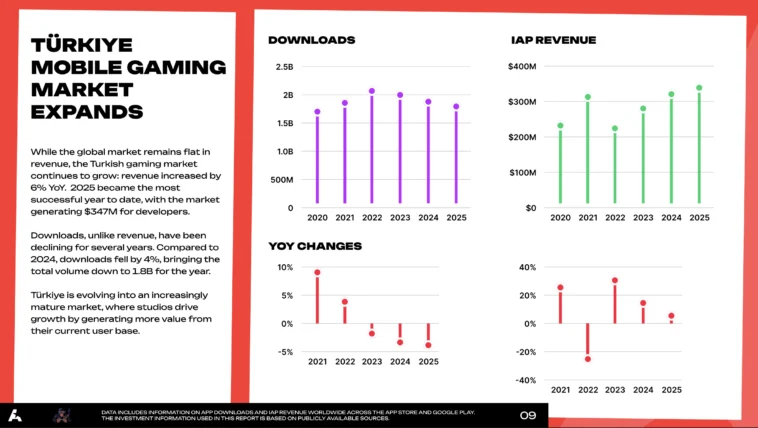
While revenue continued to grow, downloads moved in the opposite direction. Turkish-developed mobile games recorded approximately 1.8 billion downloads in 2025, down 4% year-over-year. The report identifies this divergence as evidence that developers are increasingly prioritizing monetization and long-term player value over download volume. Rollic remained one of the country’s leading publishers for installs, even as the broader market shifted toward revenue efficiency.
The findings suggest that Türkiye’s gaming ecosystem is entering a more mature phase. Revenue growth remained positive in early 2026, while download trends began to stabilize after years of rapid expansion. AppMagic notes that both metrics are showing signs of normalization as the market evolves beyond its hyper-growth stage.
Several Turkish companies continue to influence global mobile gaming trends. The report points to Dream Games’ Royal Match as a major driver of LiveOps innovation, with features and event formats frequently replicated across the casual gaming sector. Royal Match reportedly operates more than 150 LiveOps events each month, while mechanics introduced by the game have spread widely among competing titles.
Peak Games also remains one of the country’s most significant success stories. Its titles Toy Blast and Toon Blast have generated more than $3.4 billion in combined in-app purchase revenue, while newer release Match Factory! has surpassed $432 million in revenue since launch, helping reverse earlier declines in the company’s portfolio.
Beyond revenue growth, investor interest in Turkish gaming companies continues to rise. Since 2009, game developers in the country have raised approximately $3.6 billion in funding, with investment activity accelerating significantly after 2020. The report notes that companies now announce an average of 24 funding rounds annually, reflecting continued investor confidence in the sector.
The ecosystem has also produced a new generation of fast-growing studios. Loom Games reached a valuation exceeding $1 billion less than a year after its founding, while Grand Games secured $100 million in funding within a 16-month period. These developments have helped sustain interest from both local and international investors seeking exposure to the mobile gaming market.
Government support remains another factor shaping the industry’s expansion. The report notes that Türkiye continues to provide incentives for gaming companies, including reimbursement programs for user acquisition, digital marketing, platform commissions, and technology tools. During the first five months of 2026, gaming ventures accounted for 71% of all startup investment in the country, underscoring the sector’s growing importance within the broader technology ecosystem.
Although puzzle games and a handful of major publishers continue to dominate industry revenue, the report suggests that Türkiye’s gaming sector is becoming increasingly diversified through new studios, investment activity, and emerging game categories. As growth stabilizes, the next phase of the market may be defined less by download volume and more by monetization, LiveOps expertise, and the ability to build globally scalable gaming businesses.




Comments
Loading…