






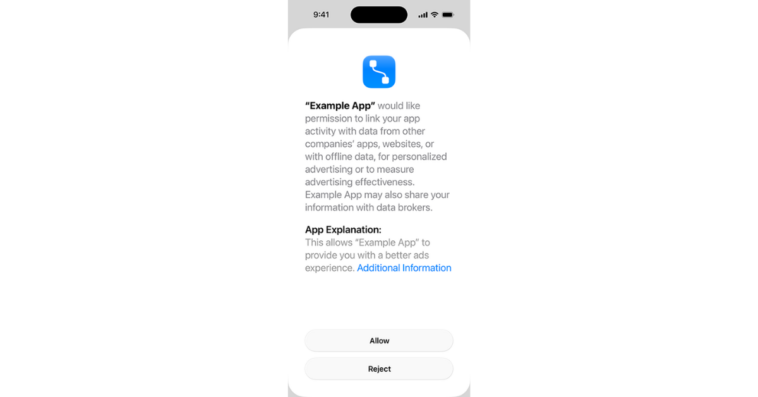
Apple is changing how App Tracking Transparency works in the European Union, introducing an alternative system prompt and allowing developers to ask users for tracking permission again one year after their previous decision.
The changes will begin with iOS 27.2 and iPadOS 27.2 and follow agreements Apple reached with select European competition authorities. Despite the revised interface, Apple says the underlying requirements determining when developers must request permission to track users will remain unchanged.
Under App Tracking Transparency, apps must obtain permission before linking user or device data with information collected from other companies’ apps, websites or offline properties for targeted advertising or advertising measurement. Permission is also required when developers share user or device data with data brokers.
The framework also controls access to Apple’s Identifier for Advertisers, or IDFA. Without ATT permission, the device’s advertising identifier is returned as a string of zeros, and developers cannot use alternative identifiers to circumvent a user’s tracking choice.
With the upcoming EU changes, developers will have the option to use an alternative version of Apple’s ATT system prompt. The revised prompt uses modified formatting and language and can include an optional text button labeled “Additional Information.”
That button gives developers a route to provide more information about why they are requesting permission to link data across companies for advertising or measurement purposes, or why they intend to share information with a data broker.
Developers can also use the additional-information layer to present more granular consent controls required under European privacy laws, including GDPR and ePrivacy requirements.
Apple says the feature is optional, and developers remain responsible for ensuring that any additional information or consent controls comply with applicable privacy regulations.
The company is also placing limits on how the expanded interface can be used. Developers cannot access the IDFA or begin collecting and using data covered by the ATT request until the user grants permission through Apple’s system prompt.
If users open the additional information screen and reject all relevant consent choices there, Apple says developers should not redirect them back to the ATT prompt. If they continue with the consent process, developers can return them to Apple’s system prompt so their final tracking choice is recorded by the ATT framework.
While the alternative prompt is optional across much of the European Union, the situation differs in five markets.
For apps distributed in Germany, France, Italy, Poland and Romania, only the alternative version of the ATT system prompt will be available due to legal requirements.
Another significant change affects how frequently developers can request tracking permission.
For users in the European Union, developers will be able to re-prompt users one year after their previous ATT choice, regardless of whether they initially accepted or rejected tracking.
That changes the long-term dynamics of ATT consent. A user who previously declined tracking can therefore receive the system prompt again after a year, giving apps another opportunity to request permission.
The same rule applies when the user previously accepted tracking, allowing developers to present the ATT choice again after the one-year period.
There is an exception. Users cannot be re-prompted if they have disabled the system-level setting that currently prevents apps from requesting tracking permission.
As part of the EU changes, Apple is also renaming the existing “Allow Apps to Request to Track” setting to “Allow Apps to Request to Link Your Activity Across Companies.”
The broader ATT rules remain in place. Developers cannot make app functionality conditional on users agreeing to tracking, nor can they offer incentives in exchange for permission.
Apps can explain why they want tracking permission before displaying the system prompt, but Apple requires those explanations to be transparent and prohibits developers from attempting to manipulate or force users into providing consent.
The rules also continue to apply beyond the IDFA itself. Apple defines tracking as the use of user- or device-level identifiers to connect app data with information from third parties for advertising, measurement or data-broker purposes.
That means developers cannot substitute hashed email addresses, phone numbers, fingerprinting techniques or other identifiers to track users who have not granted ATT permission.
Third-party SDKs are covered as well. Developers remain responsible for the behavior of advertising, attribution, analytics and other SDKs included in their apps. If an SDK combines app data with information from other companies for targeted advertising or measurement, ATT permission is required.
The upcoming changes could be particularly relevant to mobile advertisers and app marketers operating in Europe. ATT has been a central constraint on deterministic cross-app tracking on iOS since Apple introduced the framework, affecting attribution, retargeting and audience targeting strategies across the mobile advertising ecosystem.
The new EU framework does not remove that restriction. Instead, it changes how developers can communicate the permission request and introduces a recurring opportunity to ask users to reconsider their decision.
For developers, the immediate implementation difference will arrive with iOS 27.2 and iPadOS 27.2. Apps operating across Europe will need to account for the alternative prompt, while developers distributing in Germany, France, Italy, Poland and Romania will need to use the revised version exclusively.
The ability to re-prompt users after one year could also introduce a new consideration for consent strategy and user experience. Developers will need to decide whether and when another ATT request is appropriate while continuing to comply with Apple’s rules and applicable European privacy requirements.



Comments
Loading…