



 Sophie Blake
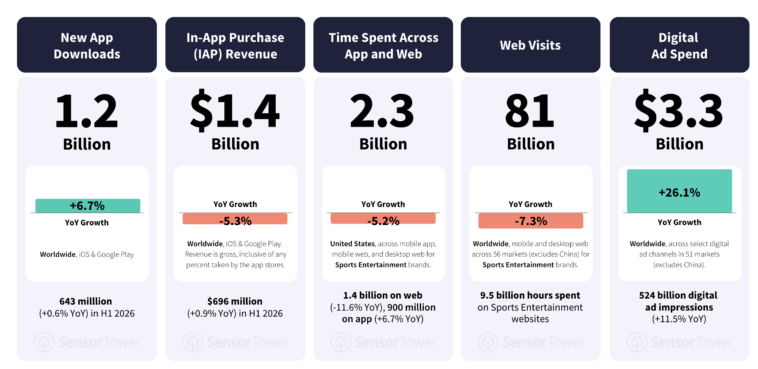
Sports News, Statistics & Live Scores apps reached a record 137 million global downloads in Q2 2026, according to Sensor Tower’s latest report, as the FIFA World Cup drove one of the largest spikes in digital sports engagement in recent years. The tournament boosted activity across mobile apps, websites, sports wagering platforms, and digital advertising, highlighting the growing role of mobile and web experiences alongside live sporting events.
Sensor Tower found that sports app demand remains closely tied to the global sports calendar, with recurring leagues and marquee tournaments continuing to shape user acquisition and engagement. While annual competitions such as the NFL, NBA, MLB, and cricket tournaments generate predictable seasonal increases, the 2026 FIFA World Cup produced a particularly strong uplift, pushing Sports News, Statistics & Live Scores apps to their highest quarterly download total on record. By comparison, Sports Streaming apps did not experience the same level of growth, partly because viewers increasingly consumed tournament broadcasts through broader streaming services rather than dedicated sports streaming apps.
Regional trends reflected the World Cup’s global reach. Latin America posted its strongest quarter ever with 77 million sports app downloads, surpassing Asia during Q2 2026 and accounting for more than one-quarter of worldwide sports app installs. Sensor Tower noted that the tournament accelerated an already positive growth trend across the region, reinforcing football’s influence on mobile engagement.
The report also highlighted sustained momentum for Sportsbook & Casino apps. Sensor Tower attributed part of this growth to Brazil’s newly regulated sports betting market, where operators including Betano and bet365 rapidly expanded following regulatory changes. As a result, sports wagering continued to strengthen alongside traditional sports content consumption during the World Cup period.
Beyond app downloads, the report shows that sports fans are increasingly shifting from desktop websites to mobile apps. In the United States, time spent on Sports Entertainment websites fell 16% year over year in Q2 2026, while time spent in Sports Entertainment apps increased 7% over the same period. Mobile apps accounted for nearly 43% of total Sports Entertainment engagement, up from 35% in Q2 2024, indicating that fans are increasingly relying on apps to follow scores, news, streaming, and betting activity.
Although overall Sports Entertainment web visits rose 8.7% quarter over quarter to more than 21 billion during Q2 2026 as the World Cup boosted seasonal demand, total visits remained more than 5% below the previous year. Time spent on sports websites also declined 5.2% year over year to approximately 2.5 billion hours. India stood out as an exception, recording more than 6 billion web visits and 854 million hours of time spent, driven largely by the popularity of the Indian Premier League and cricket-focused platforms such as Cricbuzz and ESPN Cricinfo.
The report underscores how regional sports preferences continue to shape digital consumption worldwide. Cricbuzz ranked as the world’s most-visited Sports Entertainment website between July 2025 and June 2026, followed by ESPN and ESPN Cricinfo, while regional leaders including ge.globo in Brazil and MARCA in Spain also appeared among the global top ten. FIFA climbed 74 places to become the tenth most-visited sports website globally as the World Cup began, making it one of the fastest-growing sports destinations during the reporting period.
Sensor Tower also examined the role of artificial intelligence in sports discovery. Despite growing interest in AI-powered assistants, GenAI remained a relatively small referral source for sports websites, generating approximately 33 million visits in Q2 2026. Direct traffic and organic search continued to dominate, together accounting for roughly 86% of Sports Entertainment website visits worldwide, while social media contributed around 11%.
The report identifies prediction markets as one of the fastest-growing segments of the sports ecosystem. In the United States, prediction markets expanded their share of sports wagering monthly active users from less than 1% in 2023 to 16% in H1 2026, led primarily by Kalshi. Traditional sportsbooks, meanwhile, saw their share decline from roughly 76% to 64%, while daily fantasy sports fell to 20%. Sensor Tower also found that prediction market platforms generally attracted younger and more diverse audiences than traditional sportsbooks.


Comments
Loading…