



 Maya Robertson
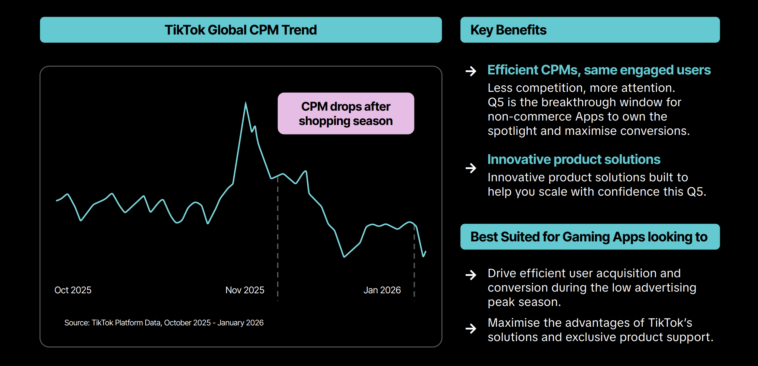
TikTok has released two marketing guides for mobile app and game advertisers, outlining user acquisition strategies for the post-holiday advertising period known as Q5. The guides cover December 1, 2026, through January 31, 2027, and focus on campaign optimization, advertising costs and opportunities to acquire users after the peak holiday shopping season.
According to TikTok, global cost-per-thousand-impression (CPM) rates typically decline after their November peak, creating a potentially less expensive advertising environment for app developers and gaming companies. The platform’s analysis of advertising activity between October 2025 and January 2026 indicates that lower media costs can coincide with continued consumer engagement, although actual campaign performance will depend on competition, targeting and other factors.
TikTok’s broader Q5 report highlights several trends affecting mobile advertisers. Citing Sensor Tower data, the company said January accounts for 12% of mobile advertising spending, compared with a monthly average of 10.5% between February and December. TikTok also reported that 85% of surveyed users expect to spend the same amount of time or more on the platform after the holidays, while 73% expect to spend the same amount of time or more downloading apps.
For mobile game developers, TikTok pointed to continued consumer spending and player activity during the period. Global mobile game spending reached $7.1 billion in January 2026, increasing 5.4% month over month, according to Sensor Tower figures cited by the company. TikTok also said its audience is between 1.3 and 1.9 times more likely to consist of core mobile gamers than the average internet audience, while 64% of surveyed users expect to maintain or increase their gaming activity after the holidays.
The gaming guide recommends that advertisers prepare their campaign budgets and creative assets before CPMs begin declining, allowing them to adjust spending as market conditions change. It emphasizes value-based optimization strategies for acquiring players who generate revenue through in-app purchases (IAP) and in-app advertising (IAA), rather than focusing exclusively on installation volume.
Among the highlighted tools is TikTok’s Day 7 Value-Based Optimization (D7 VBO), which uses early revenue signals to optimize campaigns toward higher-value users. Advertisers can choose Target ROAS bidding or Highest Value optimization, depending on whether they prioritize a specific return on advertising spend or maximizing the value generated by acquired players. TikTok notes that its SDK is required for access to the iOS IAA D7 VBO solution, while certain other optimization options are limited to Android.
The gaming playbook also recommends running campaigns for at least seven days before making significant adjustments, providing sufficient time for the platform’s optimization systems to complete their initial learning phase. TikTok advises advertisers to prepare at least 15 creative assets for relevant purchase and advertising-revenue campaigns, use Creative AutoSelect to manage creative fatigue and test interactive formats such as TikTok Playables.
For non-gaming mobile apps, the second guide focuses on TikTok’s Smart+ advertising solutions, including Max Delivery, Target Result, Highest Value and Target ROAS. These options support different campaign objectives, from increasing app installations to optimizing for subscriptions, purchases and other in-app conversions.
The mobile app guide also addresses campaign measurement, particularly for subscription-based services. TikTok recommends that developers distinguish between free-trial starts and completed subscriptions when configuring conversion events. It also outlines measurement requirements for apps combining purchases and subscriptions, emphasizing the importance of correctly reporting revenue values and conversion events to support automated bidding.
In its broader report, TikTok cited a U.S. Android study by Adjust showing that users acquired through TikTok in the health and wellness category generated 117% higher monthly revenue per user than those acquired through other channels. The company also identified social apps as a category that has experienced more efficient cost-per-acquisition rates during Q5, although it did not provide a specific CPA reduction percentage.
Both guides emphasize campaign preparation, creative testing and monitoring advertising costs rather than treating the post-holiday period as a guaranteed source of cheaper acquisitions. The recommendations reflect TikTok’s efforts to encourage advertisers to maintain or increase spending after the holiday season, when marketing budgets are often reassessed.
For mobile app marketers and game publishers, the findings suggest that the period between December and January may offer opportunities to test acquisition strategies and optimize campaigns around longer-term user value. However, the figures are drawn from different TikTok studies, internal platform data and third-party research, and do not establish that every advertiser will achieve lower acquisition costs or higher returns during Q5.

Comments
Loading…