



 Sophie Blake
China’s video game market generated $51.8 billion in revenue in 2025, up 5.4% year over year, surpassing the $50 billion mark for the first time, according to new data from Niko Partners. The research firm expects the market to continue expanding through the end of the decade as player spending rises and new monetization, discovery and development models gain traction.
Niko Partners forecasts China’s games market will grow another 4% in 2026 to $53.9 billion, before reaching $59.8 billion by 2030. That would represent a five-year compound annual growth rate of 2.9%.
The firm has also raised its outlook compared with its November 2025 forecast, citing stronger-than-expected performance from both newly released titles and established evergreen games.
Player spending is increasing alongside overall market revenue. Annual average revenue per user exceeded $70 for the first time in 2025 and is projected to reach $77.68 by 2030. Meanwhile, China’s gaming population is expected to grow to 769 million players by 2030, which Niko Partners says would maintain the country’s position as the world’s largest video games market by player count.
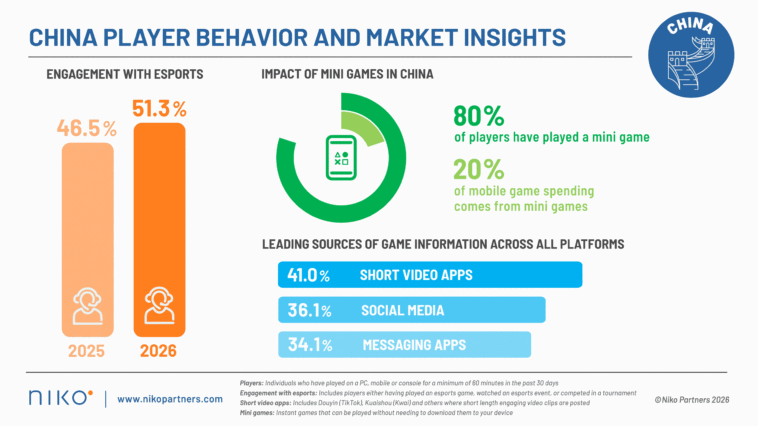
The report also highlights a shift in how Chinese players find new games. Short-form video has become the country’s leading game discovery channel, with 41% of players using short-video apps to discover games and related information across mobile, PC and console.
Mini games are becoming another significant part of the market. Niko Partners found that 80% of Chinese players have engaged with mini games, while the format now accounts for nearly 20% of mobile game spending. The figures point to mini games moving beyond reach and engagement to become a larger component of mobile game monetization.
Esports participation is also rising. 51.3% of Chinese players now engage with esports, up from 46.5% in 2025. Niko Partners defines engagement as playing an esports title, watching an esports event or participating in a tournament.
Generative AI is another area expected to influence the Chinese games industry over the next five years. Chinese companies are increasingly integrating AI into development pipelines and player-facing features, using the technology for content creation, operational efficiency and more dynamic in-game experiences.
That development is occurring alongside the expansion of user-generated content. Niko Partners says a number of successful live-service games are evolving into broader creation platforms where players can build, share and participate in their own content ecosystems.
The research firm expects niche and boutique game genres targeting underserved audiences to expand as well. At the same time, spending on both domestic and international premium PC and console titles is expected to increase, broadening growth beyond the free-to-play mobile segment.
Monetization models are also changing. Niko Partners expects greater adoption of out-of-app monetization and direct-to-fan strategies, which could allow publishers to improve margins and build more direct commercial relationships with players around both games and related intellectual property.
Regulation remains an important factor in the market’s outlook. China’s 15th Five-Year Plan for 2026–2030 includes gaming within broader initiatives covering digital innovation and cultural industries. Domestic game approvals are also running ahead of 2025 levels, providing developers with greater visibility into their release pipelines.
Niko Partners additionally expects international game companies to retain access to Chinese players through channels including Steam, while describing the regulatory environment for domestic game companies as becoming more favorable.
There are still pressures on the market. The expansion of AI infrastructure is increasing demand for memory and semiconductor components, according to Niko Partners, constraining supplies for consumer hardware and contributing to higher device prices.
Despite those constraints, Niko Partners’ revised forecast points to continued growth through 2030. With revenue already above $50 billion, the next phase of China’s gaming market is expected to be shaped not only by a growing player base, but also by higher spending per player, mini games, short-form video discovery, generative AI, premium games and new approaches to monetization.



Comments
Loading…