



 Sophie Blake
AppsFlyer is expanding its attribution capabilities to AI-driven discovery, introducing measurement for both paid ChatGPT advertising and organic traffic generated by AI answer engines.
The mobile measurement company has introduced AEO attribution alongside a ChatGPT Ads integration, giving marketers a way to distinguish between users acquired through paid AI advertising and those who arrive after organically discovering a brand in an AI-generated response.
The expansion reflects a growing measurement challenge as consumers increasingly use conversational AI platforms for product research, recommendations and purchase decisions. Traffic generated by these interactions has not always been clearly identifiable in traditional analytics systems, particularly when users move between an AI response, a website, an app store and an eventual app install.
AppsFlyer says its expanded organic search attribution now covers eight AI answer engines and 13 traditional search engines.
The supported AI platforms include ChatGPT, Claude, Perplexity, Manus, Microsoft Copilot, Gemini, Grok and DeepSeek. Traditional search coverage includes platforms such as Google, Bing, Naver, Baidu and Yandex.
AppsFlyer is positioning the capability around Answer Engine Optimization, or AEO, an emerging marketing discipline focused on improving how brands and their content appear within responses generated by AI assistants.
The system distinguishes between two types of organic AI-driven app journeys depending on whether the user already has the advertiser’s app installed.
For existing app users, a click from an AI answer or search result can open the app through Android App Links or iOS Universal Links. AppsFlyer then attributes the resulting session as a re-engagement using the referring source.
That means a user who asks an AI assistant for a recommendation, receives a response mentioning a particular service and subsequently opens that company’s app can be connected back to the answer engine that generated the visit.
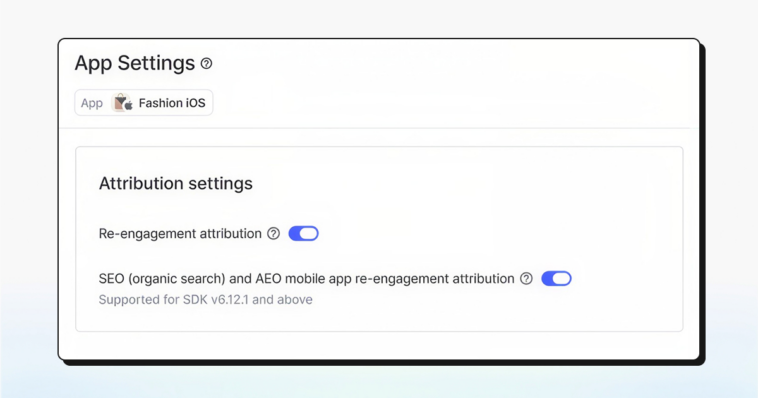
Developers and marketers can enable this form of re-engagement attribution through a setting in AppsFlyer’s App Settings.
The attribution process works differently when the user does not already have the app.
In that scenario, the user may first arrive at the advertiser’s website after clicking a link within an AI-generated response. AppsFlyer’s Smart Script can identify where the visitor originated and personalize the route from the website to the appropriate app store.
If that user subsequently installs the app, the original AI or search source can be carried through to the install attribution.
AppsFlyer says this functionality is already active in both new and existing Smart Script implementations, without requiring a separate activation.
The company is also separating AI-driven organic traffic from traditional search reporting. Marketers can compare SEO and AEO performance and, on platforms that support both paid and organic discovery, distinguish between the two acquisition paths.
ChatGPT is one of the most relevant examples because brands can now potentially reach users through both organic AI answers and paid ChatGPT Ads.
AppsFlyer’s new ChatGPT Ads integration addresses the paid side of that equation.
The integration attributes advertising campaigns through OpenAI’s Conversions API, covering conversions across both mobile apps and the web.
AppsFlyer says the integration uses the same server-side measurement infrastructure it already employs for platforms including Meta, Snapchat, TikTok and Google.
Advertisers can connect ChatGPT Ads to AppsFlyer without additional engineering work, according to the company.
Bringing paid and organic ChatGPT traffic into the same attribution environment could give performance marketers a clearer view of whether advertising is generating incremental conversions or reaching users who might otherwise have discovered the brand organically through ChatGPT.
That distinction becomes increasingly important as AI platforms operate simultaneously as discovery surfaces and advertising channels.
A consumer, for example, could ask ChatGPT for a product recommendation and reach an advertiser through an organic response. Another user could encounter a sponsored placement during a similar conversation and follow the paid route.
Without source-level attribution, those journeys can be grouped into broader categories such as direct, organic or web referral traffic, making it difficult to determine which acquisition channel generated the conversion.
AppsFlyer’s approach is designed to separate those paths so marketers can compare paid ChatGPT performance against traffic generated through AEO.
The company argues that the comparison can also help advertisers assess incrementality. If organic ChatGPT mentions are already generating customers, marketers can evaluate whether paid campaigns are bringing additional users rather than simply capturing conversions that may have occurred without advertising.
The data could also provide content and SEO teams with another performance signal. As brands increasingly optimize content for inclusion in AI-generated responses, attribution can connect those appearances with downstream app activity rather than relying primarily on visibility or referral metrics.
The announcement comes as AI assistants are developing into a new customer acquisition environment alongside search engines, social networks and app stores.
For mobile marketers, the transition introduces a more fragmented discovery funnel. Users can begin their journey inside an AI conversation, move to a website, continue to an app store and eventually install or reopen an app.
Deep linking becomes an important component of connecting those stages. AppsFlyer’s AEO attribution relies on technologies including OneLink, Android App Links, iOS Universal Links and Smart Script to preserve source information as users move between web and app environments.
AppsFlyer says both its AEO attribution capabilities and ChatGPT Ads integration are included in existing customer packages without an additional fee or separate conversion limit.
The ChatGPT Ads integration is currently live and rolling out globally alongside the expansion of OpenAI’s advertising platform.

Comments
Loading…