



 Sophie Blake
The first month of a mobile game’s launch may reveal far less about its long-term revenue potential than publishers expect. New research from Moloco shows that 87% of eventual top spenders in Whale-Driven games have not yet made their first purchase during month one, highlighting how high-value players can emerge throughout a title’s first year rather than concentrating around launch.
The finding comes from Moloco’s analysis of 55 mobile games released between January 2024 and September 2025, covering more than $1.5 billion in in-app purchase revenue and over 20 million payers. The study tracked U.S. users across iOS and Android for the first 12 months of each title, including both Moloco-attributed and unattributed revenue.
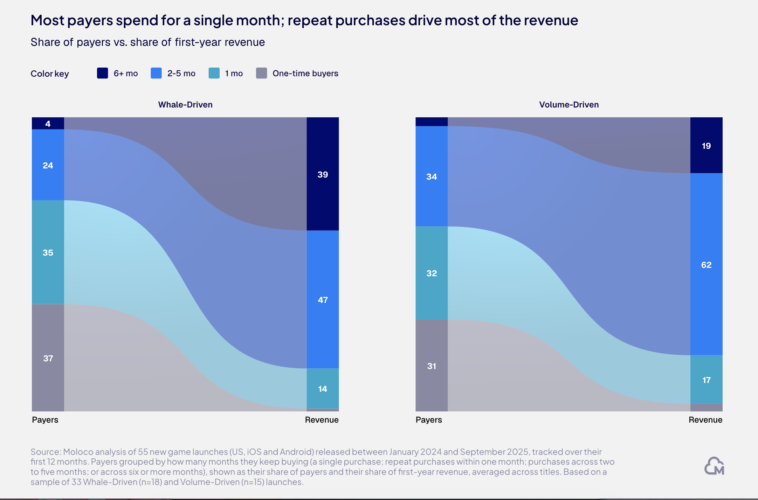
Moloco divided the games into three monetization models. Whale-Driven games generate most of their revenue from a relatively small group of high spenders, with the top 5% of payers accounting for more than 70% of revenue and ARPPU typically exceeding $100. Volume-Driven titles depend on a broader base of repeat purchasers, while Ad-Driven games primarily monetize through advertising and have comparatively limited IAP activity.
The data shows that monetization can change substantially after launch. In Whale-Driven games, average revenue per paying user was 250% higher at the end of the first year than in month one. Volume-Driven games also recorded an increase, although at a more moderate 25%. Moloco attributed much of that growth to higher purchase frequency, while Whale-Driven players also increased the size of their transactions over time.
The concentration of revenue among whales similarly develops over several months. By month 10, the top 5% of first-year payers were generating 81% of monthly IAP revenue in Whale-Driven games, compared with 54% in Volume-Driven titles. That means early revenue can appear considerably more distributed than the revenue profile that eventually develops.
High-value players also continue entering the payer base well beyond launch. Moloco found that eventual whales make their first purchases throughout the first year rather than clustering in a single period. More than a third of a title’s eventual top spenders have yet to make their first purchase by month six.
That pattern has implications for user acquisition strategies built around short payback windows. A publisher that concentrates UA spending around launch and then rapidly reduces its budget risks ending acquisition before a significant portion of its eventual highest-value users have arrived. Moloco’s analysis instead points toward evaluating players on predicted lifetime value and sustaining acquisition when longer-term signals justify continued spending.
The seven launches Moloco classified as breakout titles showed a different acquisition pattern from the remaining 48 games in the study. During launch month, 94% of their UA spend was optimized toward ROAS objectives, compared with 65% for the rest of the cohort. These titles also maintained more spending during months six through 12, when other games tended to pull back.
Moloco argues that soft launches play an important role in making that approach possible. By establishing retention benchmarks and realistic ROAS targets before worldwide release, publishers can enter general launch with campaigns already optimized toward predicted revenue rather than spending the opening months gathering the same signals.
Creative strategy also separated the breakout group from other launches. Breakout games used an average of 93 distinct creatives, compared with 37 among the remaining titles. Their advertising budgets were also less concentrated: the highest-spending creative represented 15% of spend among breakout games, versus 31% for other titles.
Rather than front-loading creative production, successful launches continued introducing new assets later in their lifecycle. 47% of breakout titles’ creatives debuted between months seven and 11, compared with 27% for the rest of the games analyzed. Breakout titles also adopted playable ads at twice the rate of other launches and expanded into longer-form video formats as their campaigns matured.
The report points to Bravestars as one example of creative diversification. Across its campaigns, playable ads generated 13.4 times more installs and 27% higher D7 ROAS than static images, according to Moloco.
These changes are occurring against an increasingly crowded mobile games market. Approximately 190,000 new mobile games were released in 2025, but only 2,500 exceeded 500,000 downloads within their first year. Paid acquisition is also taking a larger role in generating installs: the median paid share of installs among the top 10,000 new games reached 52% in 2025, up from 27% in 2022.
At the same time, the games that do break through are monetizing more aggressively. The average time required for a new release to reach $20 million in IAP and subscription revenue fell 21% between 2022 and 2025, while IAP revenue per install among U.S. users increased 126% between 2021 and 2025. Additionally, 58% of new IAP-focused launches now incorporate in-app advertising to generate revenue from users who never make a purchase.
Despite fewer games achieving large-scale download numbers, new releases have maintained a relatively stable share of overall mobile gaming IAP revenue. Moloco’s analysis found that games launched in 2023 and 2024 generated approximately 19% of gaming IAP revenue in 2025, compared with the 17% share generated in 2023 by games launched in 2021 and 2022.
The report ultimately challenges the idea that the commercial trajectory of a mobile game can be determined from its first few weeks. Monetization continues developing throughout the first year, many of the highest-value users arrive months after launch, and the titles Moloco identified as breakouts continued investing in both acquisition and creative after competitors began pulling back.



Comments
Loading…