



 Maya Robertson
Marketing mix modeling is gaining traction as a decision-making tool, but many organizations are still struggling to translate its outputs into actionable strategies, according to a joint report by Harvard Business Review and Google.
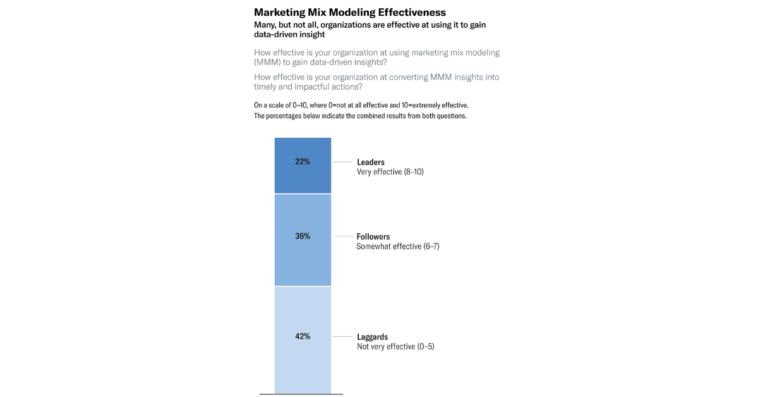
The findings indicate that while adoption is increasing, the maturity of implementation varies significantly. Around 43% of marketers say MMM has improved their media mix effectiveness, while 41% report stronger data-driven decision-making and 40% cite gains in sales or conversions. Despite these outcomes, only 22% of organizations classify themselves as highly effective at turning MMM insights into timely action.
The report segments companies into three groups: “leaders,” “followers,” and “laggards.” Leaders demonstrate both strong analytical capabilities and the ability to operationalize insights, while laggards continue to face challenges across both dimensions. A key issue identified is a disconnect in expectations, with some marketers attempting to apply MMM in the same way as attribution models such as last-click or multi-touch attribution, limiting its effectiveness.
The research highlights that MMM delivers the most value when integrated into a broader measurement framework. Organizations combining MMM with other tools report higher confidence in decision-making and a more comprehensive understanding of the customer journey. However, integration remains uneven—40% of leading organizations have connected MMM with other measurement systems, compared to just 15% among laggards.
Data quality and organizational processes continue to be primary barriers. Nearly half of respondents cite data quality as the top technical challenge, while 46% point to slow internal workflows as a major obstacle. Access to data also remains restricted, with 72% of marketers stating that MMM insights are confined to limited teams rather than being widely distributed across the organization.
At the same time, companies are actively evolving their approaches. Many are investing in dashboards and reporting tools to expand access to insights, while others are building internal expertise and aligning teams around MMM-driven decision-making. More than half of marketers now update their models at least quarterly, reflecting a shift toward more dynamic and iterative use of MMM.
The report also points to emerging technologies, changing market conditions, and shifting consumer behavior as key drivers shaping the next phase of MMM development.



Comments
Loading…