



 Maya Robertson
Agentic advertising is moving closer to day-to-day media operations, but adoption remains uneven as companies increase AI investment while continuing to grapple with security, privacy and governance concerns, according to new research from IAB Europe.
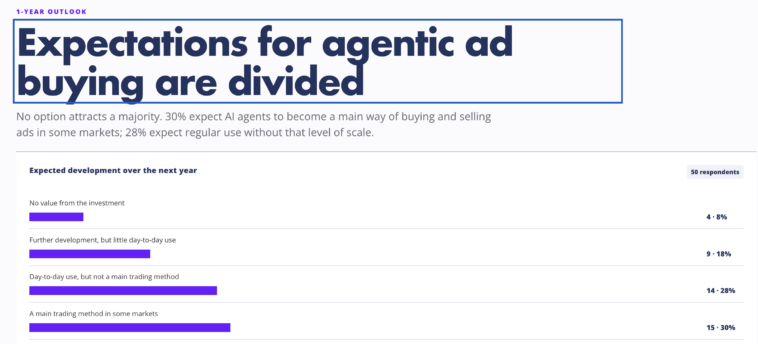
The industry group’s 2026 Impact of AI on Digital Advertising Report found that 58% of respondents expect agentic ad buying to reach operational use or scale within the next year. At the same time, the findings indicate that expectations for autonomous advertising systems remain ahead of their current deployment.
The research surveyed 50 advertising executives across 44 European markets during the spring and summer of 2026. Of those respondents, 47 said their organizations were already using AI internally, while 43 reported using it specifically for marketing.
Across the broader IAB Europe findings, 86% of respondents said their organizations use AI for marketing, showing that AI adoption itself is no longer the primary dividing line between companies. Instead, the emerging differences concern how extensively AI is being deployed, how much autonomy organizations are prepared to give it and how its performance is being measured.
Larger companies are further ahead on agentic AI
Company size is already creating a gap in the deployment of more autonomous systems.
Among respondents working at organizations with more than 500 employees, 86% said their most advanced agentic systems had reached a stage where humans and agents can jointly plan, delegate and execute work. That figure fell to 48% among respondents at companies with 500 employees or fewer.
The difference illustrates that agentic advertising is not progressing uniformly across the industry, even as expectations for the technology rise.
Among all respondents, 30% expect AI agents to become a primary way of buying and selling advertising in at least some markets, while another 28% anticipate regular operational use without reaching that level of scale. Together, those groups account for the 58% expecting agentic buying to reach operational use or scale within the next year.
Current deployment, however, remains considerably more cautious.
Thirty-six of 47 respondents told IAB Europe that their organizations either had no agentic system operating in day-to-day production or were using systems in which humans continued to direct the process or plan alongside AI agents.
The findings point to a transition from AI-assisted advertising toward greater autonomy rather than an immediate shift to fully automated media buying.
AI investment continues to rise
Companies are also allocating more money to AI.
IAB Europe found that 72% of respondents answering its investment question reported higher overall AI investment in 2026 compared with 2025, while 59% said their organizations were increasing investment specifically in AI marketing technologies.
Operational efficiency is currently the most common benchmark used to judge those investments.
Around 69% of respondents identified efficiency as a measure of AI effectiveness, even as assessments of AI’s existing performance in advertising operations remained more restrained. Respondents gave current performance an average score of 2.76 out of 5.
That gap between investment and current performance suggests companies are increasing spending partly in anticipation of what AI systems could eventually handle rather than solely on the basis of their present capabilities.
The workflows receiving AI support also remain concentrated in areas where automation can reduce manual work.
Among 29 respondents answering a question about AI-supported workflows, 22 selected reporting, analysis and dashboards as a common application. Programmatic optimization followed, selected by 59% of those respondents.
These use cases place AI primarily around analysis and optimization rather than handing complete control of advertising transactions to autonomous agents.
Security emerges as the top AI concern
As adoption increases, security has become the leading AI-related concern identified by respondents, followed by privacy.
Companies are also dealing with questions around resources and the combined management of legal, commercial, ethical and security risks as AI becomes embedded across more advertising functions.
Governance structures are developing alongside that expansion.
IAB Europe found that 78% of respondents have identified a formal owner for AI governance within their organizations, indicating that responsibility for AI is increasingly being assigned rather than handled solely through individual experimentation.
The regulatory environment adds another layer to those governance decisions, particularly in Europe.
Organizations are still assessing what the EU AI Act means for their operations, while companies deploying AI across advertising workflows need to consider how responsibility is allocated when automated systems make or influence decisions.
IAB Europe’s research also found demand for more external support. 62% of respondents said they would benefit from industry guidance on using AI for marketing.
Agentic advertising moves from experimentation toward implementation
Agentic advertising differs from conventional automation by giving AI systems greater ability to interpret objectives, plan actions and execute tasks rather than simply following predefined rules.
Within digital advertising, that could eventually allow agents representing buyers and sellers to communicate, evaluate inventory, negotiate or execute media transactions with varying degrees of human involvement.
Advertising companies have already begun developing infrastructure around that model. Digiday noted that agency holding companies including WPP and Omnicom have been developing buyer-side agents, while publishers including CNN and News UK have been working on sell-side systems.
The shift is also creating a need for common technical standards as agents developed by different companies begin interacting across the advertising supply chain.
For now, IAB Europe’s findings show an industry in an intermediate stage: AI is already widely used, spending is increasing and expectations for autonomous media buying are growing, but most companies have not yet handed substantial portions of advertising operations to independent agents.
The 58% expecting operational use or scale within a year signals how quickly that balance could change. But the report’s findings on security, governance and current performance also show that expanding agentic advertising will depend on more than technical capability alone.
As the industry moves from AI-assisted workflows toward systems capable of acting with greater autonomy, questions around accountability, interoperability, privacy and human oversight are becoming part of the infrastructure required for agentic buying to move into routine advertising operations.

Comments
Loading…